Charging your company car at home: who pays the electricity, country by country
Can you get your home electricity back for an electric company car? The rules in Belgium, the Netherlands, Germany, Italy, Spain and more, with an example.
Aubin Aycaguer, Chief of Staff, Voltaback4 Nov 2026

In most European countries, your employer can pay you back the electricity you use to charge your electric company car at home, and in Belgium, the Netherlands, Germany and the UK that reimbursement is free of income tax and social contributions when it matches the energy the car really used. Italy is the main exception: the reimbursement is allowed but taxed as salary.
This guide is for company car drivers. It explains what you need at home, what charging really costs, how much you should get back in each country (with one worked example in euros), how your charging can be measured without installing anything, what your employer sees, and what to ask HR if nothing is in place yet. It reflects what we see across the 200+ companies that use Voltaback to reimburse home charging in several European countries.
Why charging at home is the default for company car drivers
An electric company car typically spends 12 hours or more a day parked at home. Plugging in when you arrive and leaving with a full battery removes almost every detour to a public charger, and it is the cheapest energy the car will ever use.
The gap is large everywhere in Europe. A kWh charged at home at night costs roughly 0.19 € in Luxembourg on a dual-rate offer, about 0.24 to 0.25 € in Belgium on a night tariff and about 0.32 € in Germany (the energy price per kWh of a typical contract). On public chargers, the same kWh commonly costs around 0.45 € on AC and 0.60 to 0.75 € on DC fast chargers, as the Dutch figures show (Source: Tap Electric, Netherlands price survey 2026).
Every kWh you charge at home instead of on a motorway fast charger saves your employer money. Keep that in mind when you ask for a fair reimbursement: it is in the company's interest too.
What you need at home: socket, wallbox and the 1-phase or 3-phase question
You have two realistic options, and both work with a company car.
Setup | Typical power | Range added per hour (about 18 kWh/100 km) | Suits |
|---|---|---|---|
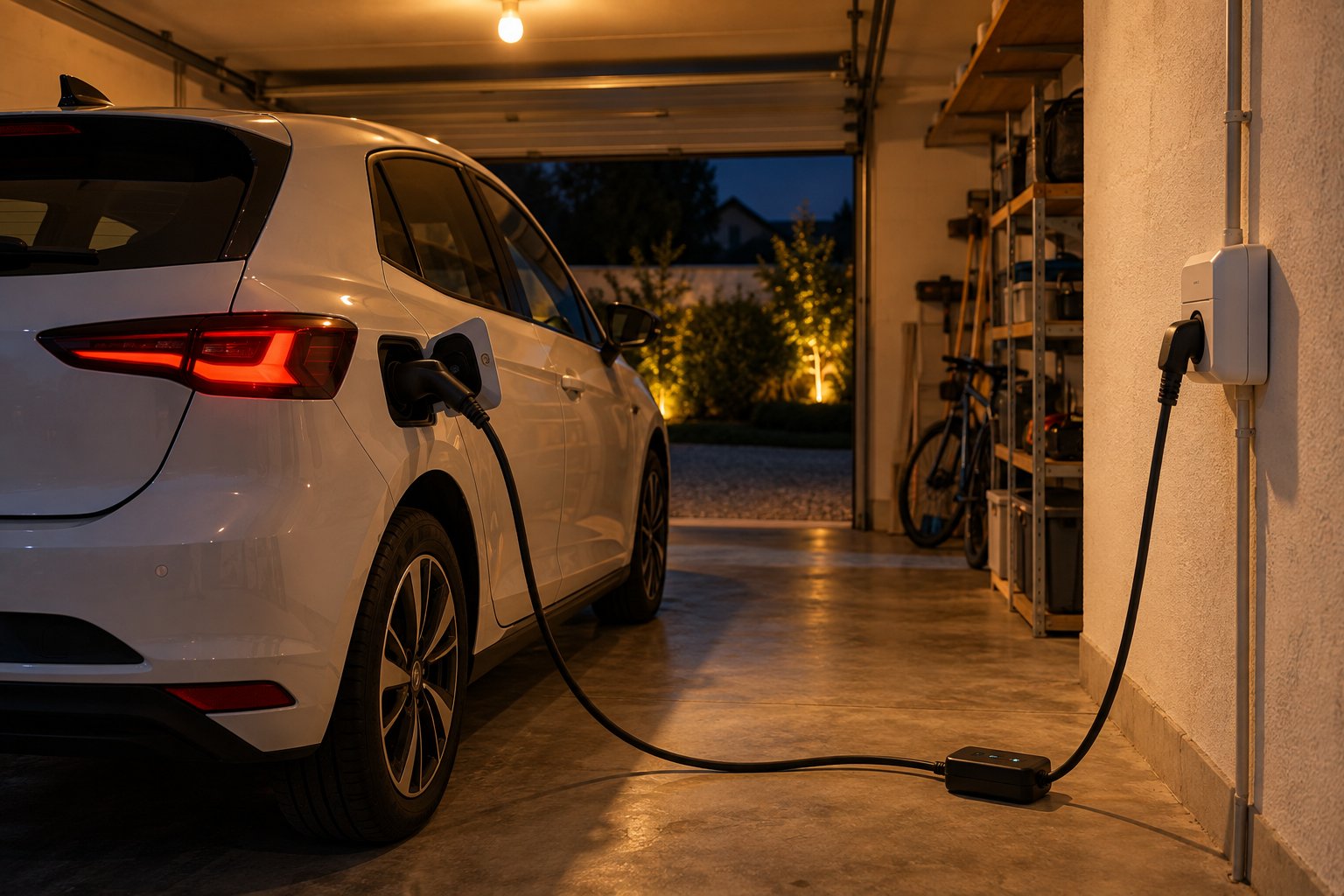
Standard household socket with the car's portable cable | 1.8 to 2.3 kW | about 10 to 13 km | Plug-in hybrids, up to about 60 km a day, 10+ hours parked |
Wallbox, single phase | 7.4 kW | about 40 km | Most battery electric cars, longer commutes |
Wallbox, three phase | 11 kW | about 60 km | Homes with a three-phase supply (common in Belgium, the Netherlands, Germany) |
A household socket is fine for many drivers, as long as the wiring is in good condition, you never use an extension lead and you follow the car maker's instructions. Our article on charging from a standard or reinforced socket covers the safety points.

A wallbox is more comfortable for a full battery car or a long commute. In continental Europe, many homes have a three-phase connection, so an 11 kW wallbox is standard; UK and Irish homes are almost always single phase, which caps home charging at about 7 kW. In Italy, the standard household contract is limited to 3 kW, so a wallbox usually needs a higher contracted power or load management. Charging times by car and power are in our guide to how long it takes to charge an electric car.
Who pays for the wallbox depends on your company's car policy: some employers fund it, others contribute, others leave it to you. Ask before ordering one, and keep the invoice.
What if you live in an apartment?
You can usually still charge at home if you have a private parking space with a power supply. The recast EU Energy Performance of Buildings Directive requires Member States to make it easier for owners and tenants to install a charging point, and allows a refusal only on serious and legitimate grounds; national laws were due by 29 May 2026 (Source: Directive (EU) 2024/1275, Article 14). Some countries already had such a right, for example Spain, where a charger in an individual space in a shared garage only requires prior notice to the owners' association (Source: Ley de Propiedad Horizontal, art. 17.5).
Charge smart: off-peak hours and contracted power
The single biggest thing you control is when you charge. Most European suppliers offer a cheaper night rate or a time-of-use or dynamic tariff, and almost every car can schedule charging from its own app, even on a household socket.

Two other levers matter in some countries:
- Capacity-based network fees. Flanders and Luxembourg charge part of the grid cost on your peak power. Charging at 11 kW while the oven and heat pump run raises that peak; limiting the charging power overnight keeps it low.
- Contracted power. In Italy and Portugal, the power on your contract decides whether a wallbox can run at full speed. Raising it costs a monthly fee, so check the numbers before you order.
Off-peak charging lowers the real cost per kWh. If your employer reimburses at your actual tariff, it also lowers the company's bill, which is exactly what a fair scheme should reward. More detail in our guide to charging during off-peak hours.
Who pays for the electricity of your company car?
The company should. You are buying energy for a car you do not own, on your personal contract, for a vehicle your employer chose to give you. No European country forces the employer to reimburse, but almost every company car policy does, and the tax rules decide how.
Three principles are common to most countries:
- The reimbursement must match measured kWh that went into the company car, not an estimate or a monthly lump sum.
- The price must be your real cost or an official rate, never more. Anything above becomes salary.
- It covers the company car only. Charging your own private car is a different case, usually taxable everywhere.
What differs is the price you may use and whether the payment is taxed.
How home charging is reimbursed in Europe: country by country
Country | How the employer pays you back | Price reference (2026) | Tax and social security |
|---|---|---|---|
Belgium | Actual cost, or a per-kWh flat rate capped by the CREG rate | Q4 2026 ceiling: 32.25 c (Flanders), 36.88 c (Brussels), 37.79 c (Wallonia) per kWh incl. VAT | Exempt up to the ceiling, with measured kWh and a written car policy |
Netherlands | Actual integral cost per kWh of your own contract | Your contract; averages are not accepted | Untaxed, no effect on your bijtelling |
Germany | Tax-free Auslagenersatz: your contract price or the Strompreispauschale | 0.34 €/kWh flat rate in 2026 (0.32 € in 2027) | Exempt (§ 3 Nr. 50 EStG); monthly lump sums ended on 1 January 2026 |
Luxembourg | Actual cost of the kWh charged, no official flat rate | Your contract, about 0.19 € at night on a dual-rate offer | In practice covered by the company car flat-rate benefit; anything above real cost is salary |
Italy | Allowed, at your real cost | Your contract (for reference, ARERA's Q4 2026 price for vulnerable customers is 43.43 c€/kWh) | Taxable salary and INPS contributions (Agenzia delle Entrate ruling 421/2023) |
Spain | Business share as a company expense, private share as a benefit | Your contract | Business km untaxed; private km (commuting included) taxed, by analogy with fuel rulings |
Portugal | Actual cost on measured kWh; no official flat rate | Your contract, often 0.15 to 0.25 €/kWh | No ruling on income tax; VAT on your bill cannot be recovered by the company |
UK | Actual cost, or HMRC's Advisory Electricity Rate per business mile | Your tariff, or 7p per mile charged at home | Actual cost exempt, private miles included |
Sources: CREG and RSM Belgium, Belastingdienst kennisgroep KG:204:2024:13, BMF letter of 11 November 2025 and Destatis, Guichet.lu, Agenzia delle Entrate ruling 421/2023 and ARERA, HMRC EIM23900 and GOV.UK advisory fuel rates.
What the table means for you, in practice:
- Belgium. The CREG rate is a maximum, not the price of your kWh. It spreads a reference household's fixed costs over the kWh, so it is usually above what a night kWh really costs you. Your employer may pay either.
- Germany. Since 2026, the old monthly flat amounts (up to 70 € a month) are gone. Your employer now needs the kWh charged, from a wallbox meter or the car's own meter, and chooses each year between your contract price and the flat rate.
- Italy. Being taxed does not mean you should not be paid. A precise reimbursement at your real price, grossed up if the company wishes, is still fairer than paying the car's energy yourself. A company charging card for public stations follows a different, more favourable rule (Source: Fiscalità dell'Energia).
- Spain and Portugal. There is no flat rate, so documented kWh at your real price are the safest base. In Spain, your employer also needs the split between business and private kilometres.
Countries not listed generally follow one of these logics. Ask your HR or payroll team which one applies to you.
How much should you get back? One car, six countries
Take a driver covering 15,000 km a year in an electric company car using about 18 kWh per 100 km, all charged at home. That is about 2,700 kWh a year.
Country and basis | Price used | Annual reimbursement | Taxed? |
|---|---|---|---|
Belgium, real night tariff | about 0.24 €/kWh | about 650 € | No |
Belgium, CREG flat rate (Flanders, Q4 2026) | 0.3225 €/kWh | about 870 € | No |
Germany, Strompreispauschale | 0.34 €/kWh | 918 € | No |
Luxembourg, dual-rate night offer | about 0.19 €/kWh | about 515 € | No (at real cost) |
Netherlands, integral cost (example contract) | 0.30 €/kWh | 810 € | No |
Italy, real cost (example contract) | 0.30 €/kWh | 810 € | Yes, as salary |
Our calculation. The Dutch and Italian prices are examples; the right figure is your own contract.
Two lessons stand out. First, the price basis changes the result by almost 80 % for the same car, so it is worth knowing which one your policy uses. Second, a flat monthly amount, still common in some companies, cannot be right for every driver: a driver doing 30,000 km a year needs twice as much as one doing 15,000 km.
Does the reimbursement include your standing charge?
It depends on the country. In the Netherlands, the integral cost per kWh includes a share of the fixed costs of your contract. In Germany, the contract-price option can include a pro-rata share of the Grundpreis, and the flat rate already reflects an all-in average. In Belgium, the CREG rate builds the fixed costs in. Elsewhere, the fair basis is the marginal price of a charged kWh: energy, per-kWh network fee, per-kWh taxes and VAT.
For the reimbursement rules seen from the employer's side, read our guide on how to reimburse home charging costs. If you are asked to file a monthly expense claim instead, our article on expense claims for EV charging explains what evidence to attach.
How your charging is measured, without installing anything
To pay you exactly, your employer needs the kWh that went into your company car, not your whole household. Your home meter cannot tell the car from the oven, the heat pump or your partner's car.
With Voltaback, you connect your car once in the driver app, in about two minutes, and upload an electricity bill so your tariff is set. Each home session is then read from the car's own data: date, duration, kWh. Nothing is installed at home, and it works on a household socket, a wallbox of any brand or a socket in a shared car park.
Voltaback relies on the home's MID-certified meter, not on a standalone cable meter. The calculation has a 1.22 % average relative error, audited by an independent third party, and more than 48 car brands are supported. At the end of each month you receive a statement and the reimbursement follows through payroll.
This approach fits the rules above. Germany's tax authorities explicitly accept the car's own meter as a source for the kWh, and the EU Data Act, applicable since 12 September 2025, gives the user of a connected car the right to access the data it generates (Source: Regulation (EU) 2023/2854).
Your privacy: what your employer sees, and what it does not
This is the question most drivers ask, and the answer should be in writing.
Your employer sees: the kWh charged at home, the date and duration of each session, the price applied and the amount reimbursed.
Your employer never sees: your location, where you drive, where the car is parked or your journeys. Voltaback does not pass geolocation to the company. The platform is ISO 27001 certified since 2 December 2025 and GDPR compliant, and in countries with works councils, this data-minimising design is what makes approval straightforward.
Does it change your benefit in kind?
In most countries, no. The private use of your company car is taxed through the benefit in kind (the bijtelling in the Netherlands, the 1 % or 0.25 % rule in Germany, the CO2-based benefit in Belgium), and a reimbursement at real cost for the car's own energy does not add to it. Italy is the exception: the reimbursement is taxed on top of the car benefit. Details in our article on benefit in kind for electric company cars.
Living in one country, working in another
Many company car drivers in Europe cross a border every day: Belgian, German and other residents working in Luxembourg, Belgians working in the Netherlands, and the reverse. As a rule, the tax treatment of your reimbursement follows the payroll that pays it, while the electricity price is the one on your own contract at home. A driver living in Belgium and employed in Luxembourg is therefore reimbursed at the real cost of a Belgian contract, under Luxembourg payroll rules. Check unusual cases (two employers, split working days) with your payroll team.
Your company does not reimburse yet? What to ask HR
Many companies electrified the fleet before they wrote the charging rules. If you are paying for your car's electricity yourself, raise it with HR or the fleet manager with four simple points:
- It is tax free in most countries when it covers only the company car's measured kWh at real cost.
- It saves the company money: every kWh charged at home instead of on a public fast charger costs the company two to three times less.
- It does not need hardware: software can measure the car's sessions and produce a monthly statement for payroll.
- It protects your privacy if the tool never shares your location.
You can point them to how home charging reimbursement works with Voltaback.
Frequently asked questions from company car drivers in Europe
No European law obliges your employer to reimburse home charging, but almost every company car policy does, because otherwise you pay for the energy of the company's car. If your policy is silent, ask HR to add a rule: in most countries the reimbursement is tax free when it matches measured kWh at your real cost.
In Belgium, the Netherlands, Germany and the UK it is not taxable when it matches the measured kWh of the company car at your real cost or the official rate. In Italy it is taxed as salary (ruling 421/2023), and in Spain the private-use share is a taxable benefit.
Sometimes. The Dutch integral cost per kWh includes a share of fixed costs, the German contract-price option may include a pro-rata Grundpreis, and the Belgian CREG rate builds fixed costs in. Otherwise the fair basis is the marginal price of each charged kWh, VAT included.
No, in most countries the benefit in kind already covers the private use of the car, and a reimbursement at real cost for its electricity does not add to it. Italy is the main exception, where the reimbursement is taxed on top of the car benefit.
The tax treatment generally follows the country of the payroll that pays you, while the price per kWh is the one on your own home contract. A cross-border worker living in Belgium and employed in Luxembourg is reimbursed at a Belgian contract price under Luxembourg rules.
With Voltaback, your employer sees the kWh charged at home, the date and duration of each session, the price applied and the amount reimbursed. It never receives your location, your routes or where the car is parked.
Get paid back for every kWh
Charging at home is cheaper for your company and simpler for you, as long as the reimbursement is exact and follows your country's rules. If your employer is looking for a way to do it in one country or across Europe, they can contact the Voltaback team.
Recommended articles
Driver
How long does it take to charge an electric car? Charging times by charger, battery and country
EV charging times on a household socket, 7.4, 11 and 22 kW and rapid chargers, by battery, with km added per night and home supply limits in Europe.
Driver
Off-peak EV charging in Europe: cheap hours by country, savings and fair reimbursement
Off-peak EV charging country by country: night and dynamic tariffs in BE, NL, DE, ES, IT, PT, LU, CH and the UK, yearly savings and fair reimbursement.
Driver
Cost of charging an electric car at home in Europe: 2026 prices per charge, per km and per country
What a full charge, 100 km and a year of home charging cost in 2026 in Germany, Belgium, the Netherlands, Luxembourg, Italy, Portugal, Switzerland, UK.