Charging your company car at home: can you claim the electricity back from your employer?
Yes, your employer can repay all the electricity you use to charge a company EV at home, private miles included, tax and NIC free. How it works in 2026.
Aubin Aycaguer, Chief of Staff, Voltaback3 Nov 2026

Yes. If you drive an electric company car, your employer can repay all the electricity you use to charge it at home, private miles included, with no income tax and no National Insurance for you or for them. HMRC's own manual says so, and electricity does not trigger the car fuel benefit charge either.
This guide explains the rule in plain terms, the two ways employers actually pay (the 7p a mile advisory rate or your real tariff), what each is worth to you in pounds, what to do if your employer pays nothing, and how to set up home charging so the claim takes no paperwork. Many employers now use software such as Voltaback to do this automatically from the car's own data, so you never send a bill or a photo of a meter.
The short answer: what HMRC allows
The rule sits in section 239 of the Income Tax (Earnings and Pensions) Act 2003 and in HMRC's Employment Income Manual at EIM23900. For a company car, HMRC's flowchart for "employee charges car at home or at a public charging point: their employer reimburses the electricity costs" reads "business and private mileage": the exemption in s.239(2) means there is no separate tax charge under the benefits code. The only condition is that the money repaid is "solely for the company car", not for the rest of your household's electricity.
Three related points from the same page are useful to know:
- Electricity is not "fuel" for the car fuel benefit charge. So even if your employer pays for every private mile, you do not get the extra fuel benefit that petrol and diesel drivers face.
- A chargepoint installed at your home for the company car is not a taxable benefit either (s.239(4)).
- A charge card your employer gives you for public charging is not a taxable benefit.
National Insurance follows the same line (HMRC's National Insurance Manual, NIM06440). The upshot: the only tax you pay on an electric company car is the benefit in kind on the car itself, which is set as a percentage of its list price.
Sources: EIM23900, HMRC, s.239 ITEPA 2003, NIM06440, HMRC.
Why the split that matters is car vs household, not business vs private
Many older articles still say private-mile reimbursement is taxable. That was HMRC's view before 2023 and it is no longer the guidance. For a company car, the question HMRC asks is not "was this mile for work?" but "was this electricity for the car?". A kettle, a heat pump or a second car on the same meter are not covered. Every kWh that went into the company car is.
That is why the evidence that counts is a reliable figure for the kWh that went into the car, and the price you paid for them. More on how to provide both without effort below.
What you need to charge at home
You do not need anything special to start, but the set-up decides how cheap each mile is and how easy your claim will be.
Option | Power | Miles added per hour (about 3.1 miles per kWh) | Suits |
|---|---|---|---|
3-pin plug with the car's portable cable | about 2.3 kW | 6 to 7 miles | Low mileage, occasional top-ups |
Smart wallbox, single phase | 7 to 7.4 kW | 20 to 22 miles | Most company car drivers |
Public slow/fast post near home | 7 to 22 kW | depends on the car | No driveway |
A 3-pin plug is fine as a backup or if you cover under about 40 miles a day, because a 10-hour night still adds 60 or so miles. Above that, a wallbox makes life easier, and every new home charger sold in Great Britain must be "smart", with default charging hours outside peak times. The home charging guide goes through the options in detail.
Practical checklist:
- Ask who pays for the wallbox. Many employers fund it, and it is not a taxable benefit for a company car.
- Use an installer registered with a competent person scheme, so the new circuit is notified under Part P of the Building Regulations.
- In a flat or a rented home, get written consent from the freeholder or the landlord first. Renters and flat owners with off-street parking can claim the government chargepoint grant of up to £500 until 31 March 2027 (see OZEV grants).
- No driveway? A cross-pavement channel may qualify for the on-street grant, with your council's consent.
Do I need a smart meter?
No, you can charge and be reimbursed without one. You do need a smart meter for most EV tariffs, which is where the big savings are. The guide to charging without a smart meter explains what changes.
Switch to an EV tariff: the biggest saving on your bill
The single most useful thing you can do is move to an EV or time-of-use tariff. Under the Ofgem price cap for October to December 2026, a standard variable tariff costs 26.32p per kWh on average. EV tariffs sell a nightly window, usually four to seven hours, at roughly 7p to 9p per kWh, according to What Car?'s May 2026 comparison.
On 8,000 miles a year, that is the difference between about £670 and about £180 of electricity. The EV tariffs guide compares the tariff types and the windows.
Two practical tips:
- Set the charging schedule once, in the car's app or the wallbox app, to match your off-peak window.
- Remember that your whole house also gets the cheap rate during that window, and a dearer rate during the day. That matters for how your employer values your charging, as the next section shows.
Sources: Ofgem price cap, October to December 2026, What Car? EV tariffs.
Who pays for the electricity: the two methods employers use
UK employers use one of two methods. Both are legal. They give very different results depending on your tariff and how much of your driving is private.
Method 1: the Advisory Electricity Rate per business mile
HMRC publishes an Advisory Electricity Rate (AER) for fully electric company cars: 7p per mile when you charge at home and 15p per mile at public chargers, in force from 1 September 2026. HMRC reviews it every quarter (1 March, 1 June, 1 September, 1 December).
- It is a rate per business mile. It does not pay for private miles.
- It ignores your actual tariff. HMRC assumes about 3.59 miles per kWh.
- If you charged both at home and in public for a trip, the miles can be split "fair and reasonable" between the two rates.
Source: Advisory fuel rates, HMRC.
Method 2: the real cost of your electricity
Your employer repays the kWh that actually went into the car, at the price you actually paid for them. Because of s.239(2), this can cover every mile, business and private. This is the method that makes home charging free for the driver.
The catch, historically, was evidence. Drivers had to send bills, meter photos or charger app exports, and payroll had to check them. That is the job software now does: a reimbursement app reads each charging session from the car and values it at your tariff at that time.
How much you get back with each method
The figures below use a realistic 0.32 kWh per mile (about 3.1 miles per kWh, winter included) and 10,000 business miles a year.
Your home tariff | Electricity cost for 10,000 miles | AER paid (7p x 10,000) | Your gain or loss with AER |
|---|---|---|---|
EV tariff, 7p/kWh | about £224 | £700 | about +£476 |
Blended 15p/kWh | about £480 | £700 | about +£220 |
Price cap, 26.32p/kWh | about £842 | £700 | about -£142 |
Fixed deal, 28p/kWh | about £896 | £700 | about -£196 |
With real-cost reimbursement, the gain or loss is always zero: you get back what you paid.
Now add private miles. Say you also drive 6,000 private miles a year and charge all of it at home:
- With AER only, those miles are on you: about £134 a year on a 7p tariff, about £505 on the price cap.
- With real-cost reimbursement, your employer can pay them too, tax free.
So the rule of thumb is simple. On a cheap EV tariff with lots of business miles, the AER can leave you slightly ahead. On a standard tariff, or with lots of private driving, real cost is clearly better for you. The employer's guide to managing home charging shows the same choice from the company's side.
What about public charging?
At 15p a mile, the public AER equals about 47p per kWh at our consumption. Zapmap's index puts the average rapid and ultra-rapid price at 79p per kWh in September 2026, so a rapid-charged mile costs you about 25p. If you rely on rapid chargers, ask for a company charge card: it is not a taxable benefit, and you pay nothing out of pocket.
Source: Zapmap charging price index.
How your charging is measured, without installing anything
To repay "solely the company car", your employer needs the kWh the car took on, session by session, and the price of each kWh. There are three ways to get them:
- A separate meter on the charger circuit. Accurate if it is a certified meter, but it costs an electrician's visit and only works with a wallbox.
- The wallbox app. Convenient, but only if you have a connected wallbox, and the export usually has to be sent by hand.
- The car's own data. Every recent EV records each charging session: energy added, time and whether the car was at home. No hardware to fit, works with a 3-pin plug too.
Voltaback uses the third route. It connects to the car's manufacturer account (more than 48 brands), detects each home session and values it at your tariff at the time of charging, including the cheap night rate. For the household side, Voltaback relies on the home's MID-certified meter, not on a standalone cable meter, so the price used is the one on your real bill. The accuracy of the measurement has been audited by an independent third party, with a relative error of 1.22 %.
For you, it looks like this in the driver app: connect the car once, enter or link your tariff, then each month see the sessions and the amount that will be paid with your salary. Your employer receives a monthly export ready to import into payroll.
Your privacy: what your employer sees and does not see
A fair question when an app reads your car. With Voltaback:
- Your employer never receives your car's location. The app knows whether a session happened at home, not where you drove.
- Your employer sees the kWh charged at home, the cost per session and the monthly total to reimburse.
- Data is processed under UK GDPR, and Voltaback has been ISO 27001 certified since 2 December 2025.
If your employer also tracks business mileage for the AER, ask how private journeys are handled. The Information Commissioner's Office expects monitoring of workers to be necessary, proportionate and explained in advance.
Tax and benefit in kind: what does not change for you
Repaid electricity adds nothing to your tax bill. What you pay tax on is the car's benefit in kind (BIK): its list price times the "appropriate percentage" for its CO2 band.
Tax year | Zero-emission car |
|---|---|
2026 to 2027 | 4 % |
2027 to 2028 | 5 % |
2028 to 2029 | 7 % |
2029 to 2030 | 9 % |
On a £40,000 electric car in 2026 to 2027, the taxable benefit is £1,600: £320 a year for a basic-rate taxpayer, £640 for a higher-rate taxpayer. A petrol car of similar size often sits around 30 %, so the same list price would mean a £12,000 benefit. The guide to BIK on electric company cars goes into the bands and the plug-in hybrid rules.
Sources: Company car benefit, appropriate percentages, HMRC, company car tax rates to 2031 to 2032.
Salary sacrifice cars
If your car comes through a salary sacrifice scheme, it is still a company car for tax: the same s.239 exemption applies. The monthly sacrifice usually covers the lease, insurance and maintenance, sometimes a home charger, but not the electricity. So the question "who pays for the kWh?" is exactly the same, and your employer can repay them tax free in the same way.
A temporary bonus: 0 % VAT on home electricity
From 1 October 2026 to 31 March 2027, domestic electricity in Great Britain is zero-rated for VAT instead of 5 %. Your home kWh are a little cheaper, while public chargers still charge 20 % VAT. One more reason to charge at home.
Source: Revenue and Customs Brief 10 (2026), HMRC.
Your employer does not reimburse yet? What you can do
Claim tax relief on business miles
If your employer pays nothing for the electricity of a company car, HMRC's manual says you may deduct the electricity cost of your business miles (ss.337 and 338 ITEPA 2003). Private miles get no relief. Keep a mileage log and the cost of the electricity, then claim with form P87 if you do not file a Self Assessment return. The relief is worth your marginal tax rate on the cost: 20 % or 40 % of it, not the full amount.
Source: Claim income tax relief for employment expenses (P87), HMRC.
Talk to HR or the fleet manager
Tax relief on business miles is a poor substitute for being repaid. A short, factual request often works, because the change costs your employer no tax:
- Quote EIM23900: reimbursement for a company car is tax and NIC free, private miles included.
- Point out the fairness issue: drivers on standard tariffs lose money with the 7p rate, those on EV tariffs gain.
- Mention that there is nothing to install: a reimbursement app reads the car, and payroll gets one export a month.
- Propose an interim: AER on business miles until the new process is in place.
You can forward them the Voltaback driver page or the expense claim guide for home charging, which covers what to send while there is no automatic process.
Charging a company car at home: your questions
Yes. Your employer can repay the full cost of the electricity used to charge your electric company car at home, for business and private miles, with no tax or NIC (EIM23900, s.239(2) ITEPA 2003). Whether they do is a policy choice: some pay the real cost, others pay the 7p advisory rate per business mile, and some pay nothing.
No. Electricity is not fuel for the car fuel benefit charge, and repaying the cost of charging a company car is exempt under s.239(2). A home chargepoint paid for by your employer is also exempt. You only pay BIK on the car itself, at 4 % of the list price in 2026 to 2027.
If they use HMRC's advisory rate, it is 7p per business mile for home charging and 15p for public charging, from 1 September 2026. HMRC reviews these rates every quarter. If they reimburse the real cost, there is no per-mile rate: you get back the kWh charged at your actual tariff.
No. HMRC requires the reimbursement to be solely for the company car, but it does not prescribe a meter. A dedicated meter, a smart wallbox's records or the car's own charging data can all provide the evidence. Reimbursement apps that read the car need no extra hardware.
You can claim tax relief on the electricity cost of your business miles only, under ss.337 and 338 ITEPA 2003, usually with form P87. Private miles get no relief. The relief equals your tax rate on the cost, so being repaid by your employer is worth far more.
Not with Voltaback. The company never receives the car's location: it only sees the kWh charged at home, their cost and the monthly amount to repay. Any monitoring of workers must be necessary, proportionate and explained, in line with UK GDPR.
Usually not. A salary sacrifice package typically covers the lease, insurance, maintenance and sometimes a home charger, but not the electricity. As the car is still a company car for tax, your employer can repay your home charging tax free on top.
Get your home charging repaid at your real tariff
With an electric company car, home charging should cost you nothing, and HMRC has made that possible since 2023. What is usually missing is a simple way for your employer to measure the car's kWh and pay them at your tariff.
Voltaback does that from the car, with no box, no meter and no paperwork for you: you connect your car in the driver app, and your employer pays you monthly through payroll. If you are the person who decides, talk to our team about setting it up for your fleet.
Recommended articles
Driver
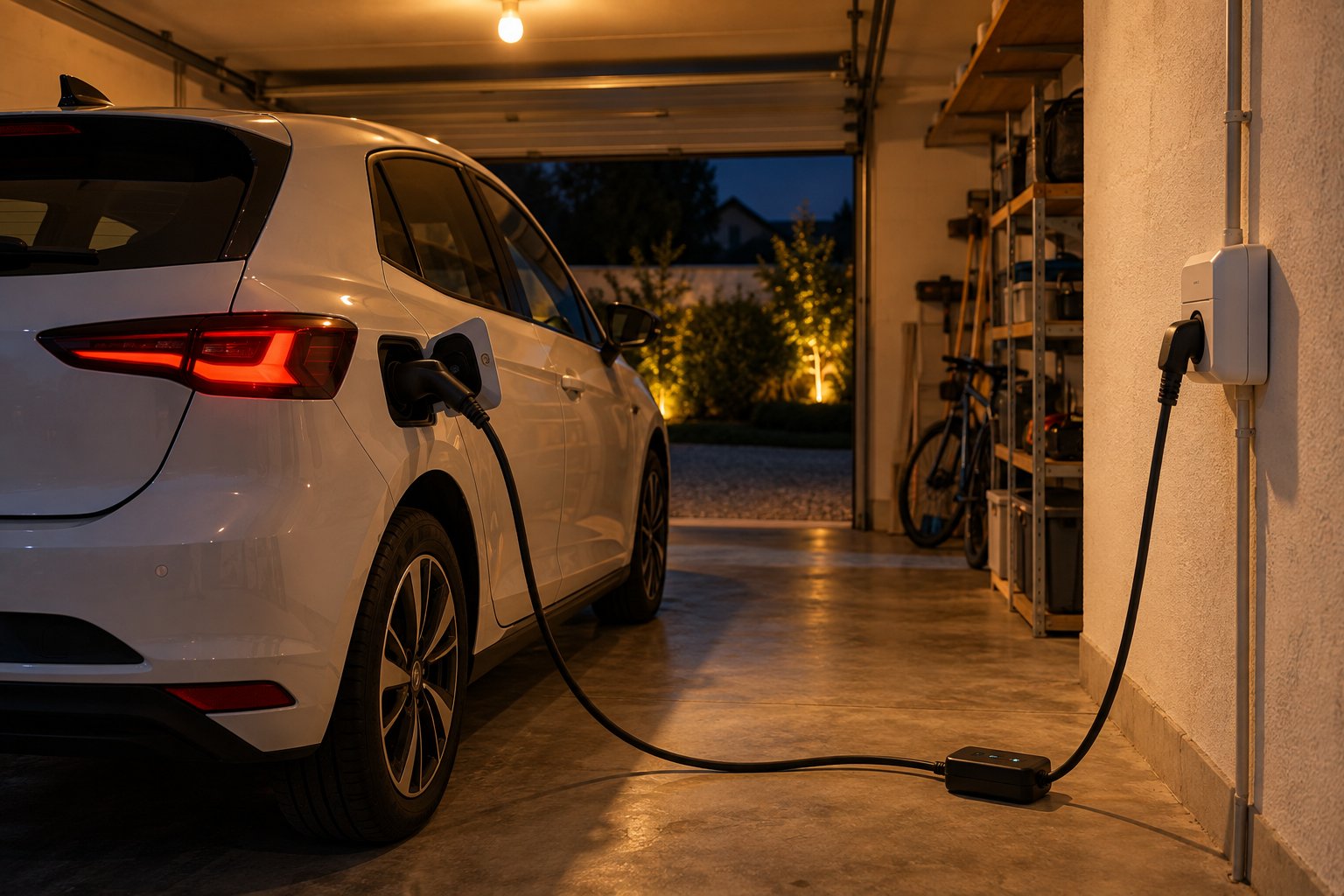
How long does it take to charge an electric car? UK times by charger, and miles added overnight
How long to charge an electric car in the UK: 3-pin plug, 7 kW home charger, 22 kW and rapid. Tables by battery, miles per hour and miles added overnight.
Driver
EV tariffs explained: off-peak charging windows, prices and how employers should reimburse them
Economy 7, fixed EV tariffs, smart and Agile tariffs compared, with windows, prices and savings, and how employers should repay off-peak charging.
Driver
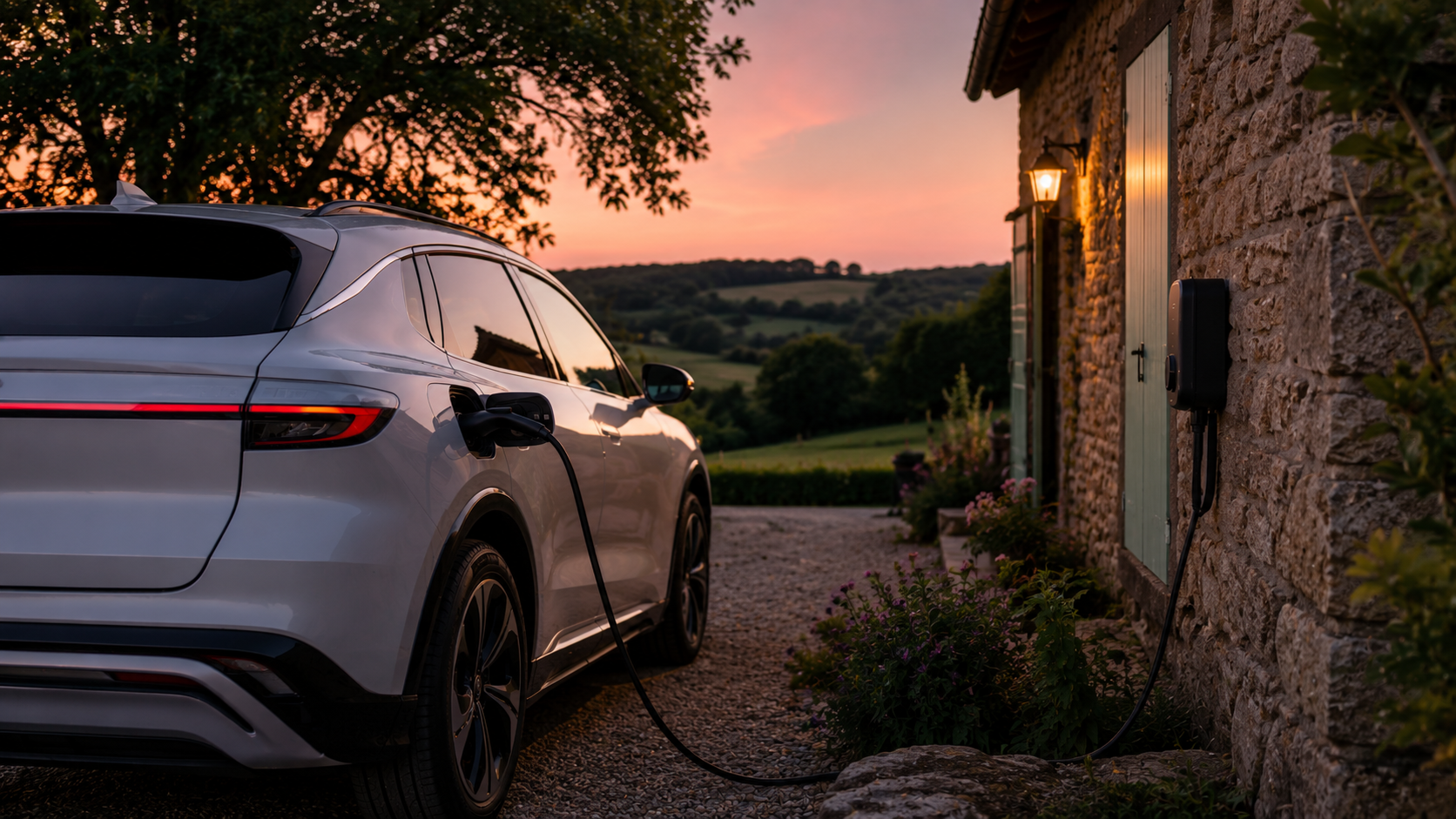
Charging an electric car at home in the UK: 3-pin plug or wallbox, and how to set it up
3-pin plug, commando socket or 7 kW wallbox? Miles per hour, fuse size, costs, grants, installer rules and EV tariffs for charging an EV at home in the UK.