Can you charge an electric car with a 3-pin plug? Safety, speed and the best socket setup
Yes, a UK 3-pin plug charges an EV at about 2.3 kW: 7 miles per hour. Safety rules, overnight miles, commando socket option and when a wallbox pays off.
Aubin Aycaguer, Chief of Staff, Voltaback3 Nov 2026

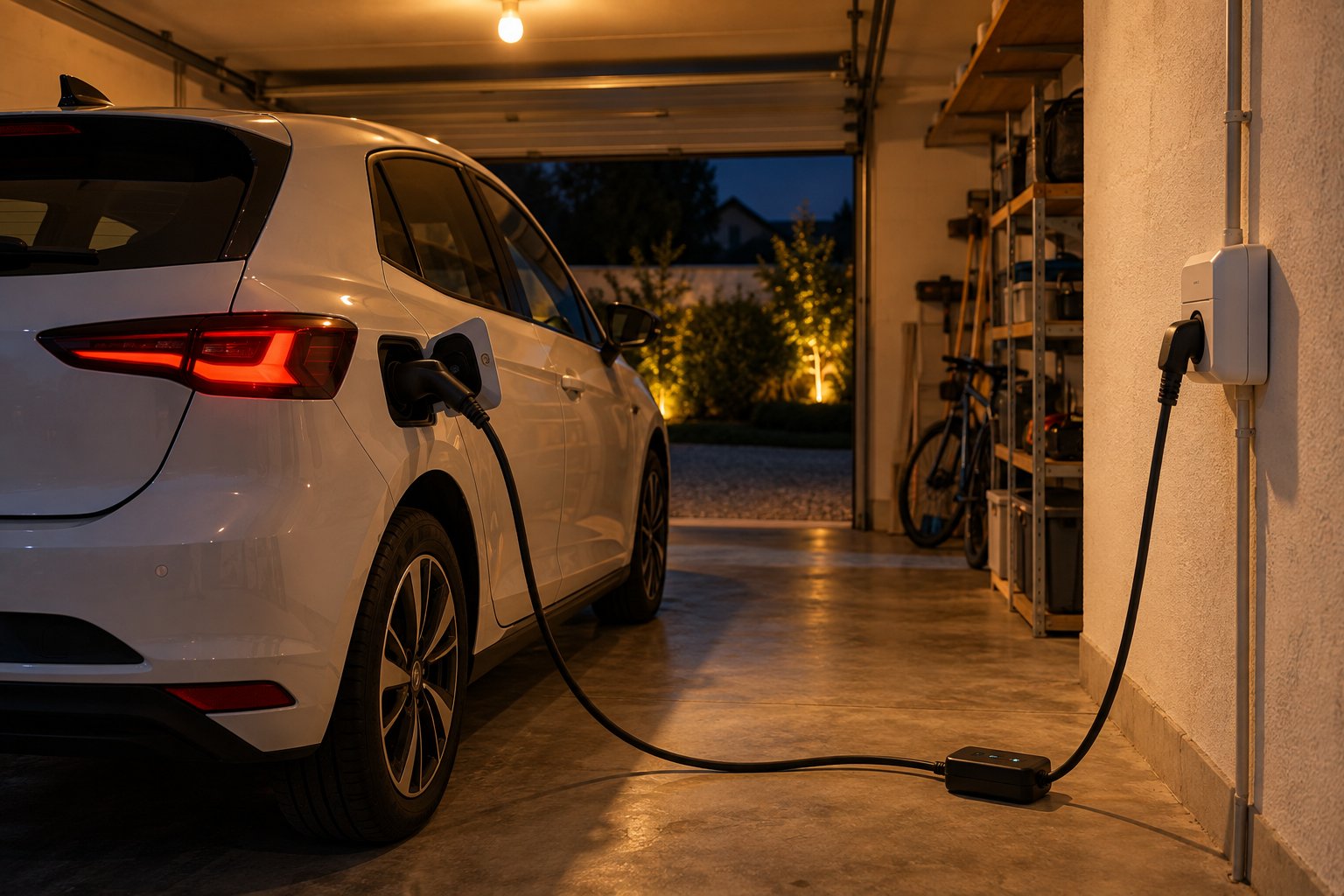
Yes, you can charge an electric car from a standard UK 3-pin plug, using the portable "granny" cable supplied with most cars. It is slow (about 2.3 kW, so roughly 7 miles of range per hour) and it is only safe on a socket and circuit in good condition, never through a household extension lead.
For a driver who covers 20 to 40 miles a day, that is often enough: ten hours plugged in overnight adds around 70 miles. Above that, or with a short cheap-rate window, a 16 A commando socket or a 7 kW wallbox becomes worth its cost.
This guide covers the speed you can really expect, the safety rules UK electricians apply, the commando option, how 3-pin charging works with smart tariffs, what each setup costs, and how company car drivers get every charge repaid, whatever the socket.
The essentials in 30 seconds
- Speed: a 3-pin cable is usually limited to 10 A, about 2.3 kW: 7 to 8 miles of range per hour, 70 to 75 miles in 10 hours.
- Safety: plug straight into a wall socket in good condition, ideally on its own RCD-protected circuit; no multi-socket extension lead, no reel left coiled.
- The middle option: a 16 A commando socket (BS EN 60309) on a dedicated circuit gives about 3.7 kW, roughly 60 % faster, for a fraction of a wallbox.
- The wallbox threshold: over about 1,000 miles a month, two EVs in the household, or a cheap-rate window of 4 to 6 hours.
- Company car: your employer can repay all the electricity tax free. Voltaback reads the car, so it works on a 3-pin plug as well as on a wallbox.
3-pin plug, commando socket or wallbox: the three ways to charge at home
UK homes run on 230 V single-phase. That limits home charging to three practical setups, which differ in power, cost and how much control you get over when the car charges.
Setup | Plug and standard | Typical power | Range added per hour | Cost to set up |
|---|---|---|---|---|
3-pin socket + granny cable | BS 1363 13 A plug, cable limited to 10 A | about 2.3 kW | 7 to 8 miles | £0 if the socket is suitable; a new outdoor socket costs a few hundred pounds |
Commando socket + portable charger | BS EN 60309 blue 16 A | about 3.7 kW | 11 to 12 miles | a dedicated circuit and socket, usually a few hundred pounds fitted |
Wallbox (Mode 3) | Type 2, tethered or socket | 7 to 7.4 kW | about 22 miles | £800 to £1,200 fitted for a standard install |
Range per hour assumes HMRC's own efficiency figure for company electric cars, 3.59 miles per kWh, and about 10 % of energy lost in charging. A large SUV in winter will add less, a small hatchback in summer more.
The granny cable is technically a Mode 2 charger: a plug, a cable and an in-line control box (the "ICCB") that talks to the car and cuts the power if something goes wrong. A wallbox is Mode 3: the control electronics live in a fixed unit on its own circuit. That difference explains most of what follows on safety and smart charging.
How fast is a 3-pin plug in practice?
A UK 3-pin socket is rated 13 A, but almost every granny cable is set to draw 10 A, or less, by default. The reason is heat: a plug and socket carrying 13 A for 10 or 15 hours, every night, run warm, and a worn socket or loose terminal can overheat.
At 10 A on 230 V you draw about 2.3 kW. Some cables let you select 6, 8, 10 or 13 A; the lower settings are for sockets you are unsure of, and the 13 A setting is best kept for a socket an electrician has checked.
Miles added overnight
The table below compares the range added in three typical windows: a 4-hour fixed cheap-rate slot, a 6-hour smart tariff window, and a full night of 10 hours.
Charging power | 4 hours | 6 hours | 10 hours |
|---|---|---|---|
3-pin, 10 A (2.3 kW) | about 30 miles | about 45 miles | about 73 miles |
3-pin, 13 A (2.9 kW) | about 37 miles | about 55 miles | about 92 miles |
Commando 16 A (3.7 kW) | about 48 miles | about 70 miles | about 118 miles |
Wallbox (7 kW) | about 88 miles | about 133 miles | about 220 miles, or a full battery |
Read it against your own driving. A driver doing 30 miles a day (the round trip of many UK commutes) recovers that comfortably on a 3-pin plug overnight. A sales driver doing 120 miles a day does not, and will end up at public rapid chargers, at three to ten times the price of home electricity.
A full charge from empty
From empty, a 60 kWh battery needs about 66 kWh from the socket once losses are counted. On 2.3 kW that is close to 29 hours. In real life you rarely start at zero: most drivers plug in at 30 to 50 % and top up to 80 %, which on a 3-pin plug is a 10 to 15 hour job.
For the full picture by battery size and power level, see our guide on how long it takes to charge an electric car.
Is it safe to charge an EV from a 3-pin socket?
It is safe when the socket, the wiring behind it and the cable are in good condition and nothing sits between the cable and the wall. The risk comes from sustained current: a kettle draws 13 A for three minutes, a car draws 10 A for ten hours.
The rules UK electricians and safety bodies apply
- No household extension lead. Electrical Safety First advises against domestic multi-socket leads and against daisy-chaining leads. A lead that is unavoidable must be rated for outdoor use and fully unwound, because a coiled reel heats up. Source: Electrical Safety First, electric vehicles.
- Get the wiring checked first. Older wiring may not cope with overnight charging. An electrician can test the circuit, the socket and the earth, and confirm RCD protection.
- Prefer a dedicated circuit. A socket on its own circuit, protected by an RCD, means the car never shares a circuit with the washing machine or a heater.
- Use a weatherproof outdoor socket. If the cable runs outside, the socket should be an IP-rated outdoor unit with a lid that closes over the plug, mounted where water cannot pool.
- Buy the cable from a reputable source. The charity also warns against second-hand chargers and unknown third-party sellers. The car maker's own cable, or a cable from a known UK brand, is the safe choice.
- Check the plug after a session. A plug or socket that is hot to the touch, discoloured or smells of burning is a sign to stop and call an electrician.
Electricians in the UK work to BS 7671 (the IET Wiring Regulations) and to the IET Code of Practice for Electric Vehicle Charging Equipment Installation, now in its 5th edition. A new circuit is notifiable work under Part P of the Building Regulations in England, so use an electrician registered with a competent person scheme (NICEIC, NAPIT and others), who self-certifies the work and gives you a certificate.
Checklist before you charge from a socket
- Find the right socket. A single wall socket close to the car, not a double socket already feeding other appliances.
- Ask an electrician for a check. Circuit rating, condition of the socket and terminals, earthing, RCD protection, and whether a dedicated circuit is advisable.
- Fit an outdoor socket if the cable would pass through a door or window. A cable trapped in a door frame or window gets crushed and lets water in.
- Set the current. Start at 10 A, or lower on a socket you are unsure of.
- Route the cable safely. Off the path, not across a pavement, with the control box off the ground.
- Feel the plug after the first long session. Warm is normal, hot is not.
- Inspect the cable every few weeks. Cuts, crushed sections and a cracked control box mean replacement, not tape.
Car makers' position
Most car handbooks allow 3-pin charging for occasional use and recommend a wallbox for daily charging. Some cars default to a lower current on a 3-pin cable. Check your handbook before relying on it every night, and keep the cable that came with the car rather than an unknown replacement.
The commando socket: the middle option
A commando socket is the blue, round industrial connector (BS EN 60309, 16 A), familiar from caravan sites. On a dedicated 16 A circuit it delivers about 3.7 kW, roughly 60 % more than a 3-pin plug, without the heat stress of a domestic socket.
What you need:
- A dedicated circuit from the consumer unit, with RCD protection, fitted by a registered electrician.
- An outdoor-rated commando socket, usually IP44 or better, close to where you park.
- A portable charger with a commando plug, or a cable with interchangeable plugs. Several car makers sell one, and some portable units come with both a 3-pin and a commando adapter. Check that your car's cable accepts it before ordering the socket.
The commando route makes sense for a renter who cannot fit a wallbox, a holiday home or a second property, a small workplace with a few occasional EV users, or a driver who needs a bit more than 3-pin speed but not 7 kW.
Its limits: it is not a smart chargepoint in the regulatory sense, so the cable or the car has to do the scheduling, and it does not qualify for the government chargepoint grant, which funds eligible smart chargepoints only.
Choosing a granny cable
If your car came without one, or you want a second cable for another address, look at five points:
- Connector on the car side. Almost all current EVs sold in the UK use Type 2. A few older models use Type 1.
- Selectable current. A cable that offers 6, 8, 10 and 13 A lets you match the socket. A fixed 10 A cable is fine for most homes.
- Length. 5 m covers most driveways; 10 m avoids stretching the cable, but every extra metre adds weight and loss. Never add an extension lead to reach.
- Protection in the control box. Earth monitoring, temperature sensing in the plug, and DC fault detection are the features that make the difference on a long session.
- Smart features. Some Mode 2 cables add an app, scheduling and energy readings. They are useful if your car cannot schedule a charge itself, and they are covered in our comparison of smart granny chargers.
A car maker's own cable is the reference choice for warranty purposes. Many cars let you schedule the charge from the dashboard or the app, which makes a basic cable perfectly adequate.
Smart tariffs and a 3-pin plug: what works
The cheapest home electricity for an EV comes from smart or time-of-use tariffs. Octopus advertises its Intelligent Octopus Go at 6.5p/kWh for up to six hours a day of smart charging between 11.30pm and 5.30am. Other suppliers run similar offers. Source: Octopus Energy, Intelligent Octopus Go.
Two things decide whether you can use them on a 3-pin plug:
- The meter. Time-of-use tariffs need a smart meter that records half-hourly consumption.
- Who controls the charge. "Intelligent" tariffs schedule the charge themselves, either through a compatible smart charger or directly through a compatible car. Octopus checks eligibility by car registration. If your car is supported, the tariff can work with a granny cable, because it controls the car, not the socket.
The catch is the window. Six hours at 2.3 kW is about 14 kWh, or 45 miles. Anything beyond that is charged at the day rate. On a fixed four-hour cheap-rate slot, a 3-pin plug only adds about 30 miles at the low price. That is the main financial argument for a wallbox: it fits a whole week's driving into the cheap hours.
For how to set up timed charging and compare windows, read our guide to charging an electric car at home.
When is a wallbox worth it?
A 7 kW wallbox costs £800 to £1,200 installed for a standard job, more if the cable run is long or the consumer unit needs upgrading. The full budget is broken down line by line in our guide to home EV charger installation costs.
It pays off when at least one of these applies:
- You drive more than about 1,000 miles a month. That is around 280 kWh of charging a month, which a 3-pin plug can only deliver by being plugged in almost every night for the full night.
- Your cheap-rate window is short. Four to six hours at 2.3 kW cover 30 to 45 miles; at 7 kW, 90 to 130 miles.
- Two EVs share the driveway. One socket cannot serve both overnight.
- You want the car ready any morning, including after an unplanned long day.
- Your socket or wiring is old and an electrician would rather not run 10 A through it every night.
Worked example: 3-pin plug versus wallbox for a 12,000-mile driver
A driver covers 12,000 miles a year, so 1,000 miles a month, mostly at home. At about 3.3 miles per kWh drawn from the socket, that is around 3,650 kWh a year.
- 3-pin plug only: the 6-hour cheap window covers about 45 miles a night, so roughly 1,350 miles of a 30-night month. In practice the driver plugs in most nights and a share of charges spills into day-rate hours or onto public chargers.
- Wallbox: all 3,650 kWh fit in the cheap window. At 6.5p/kWh that is about £237 a year, against about £960 at the October to December 2026 price cap unit rate of 26.32p/kWh.
The gap between charging fully off-peak and charging a third of the time at the cap rate is roughly £240 a year for this driver. That is why a wallbox at £900 to £1,000 pays back in three to five years for high-mileage drivers, and why a 3-pin plug remains the rational choice for someone covering 5,000 miles a year.
What each setup costs in 2026
Item | Typical price range | Comment |
|---|---|---|
Granny cable (supplied with the car) | £0 | Check it is in the boot of a used or leased car |
Replacement Mode 2 cable from a UK brand | about £120 to £300 | Smart versions add an app and energy readings |
New outdoor IP-rated socket on existing circuit | a few hundred pounds | Price varies with cable route and testing |
Dedicated circuit + commando socket | usually a few hundred pounds | Needs a spare way in the consumer unit |
7 kW smart wallbox, standard install | £800 to £1,200 | Supplier bundles from about £949 installed |
Prices for socket work depend on the distance from the consumer unit and on its condition. Ask for a fixed quote that includes the certificate and the Part P notification.
Grants: only for wallboxes, and only for some households
The government's EV chargepoint grant pays 75 % of the cost of buying and installing a chargepoint, up to £500, for renters and flat owners with private off-street parking. Owners of houses are generally excluded. It funds eligible smart chargepoints fitted by an authorised installer, not a 3-pin or commando socket. Source: gov.uk, EV chargepoint grant and eligibility.
Renting, flats and shared parking
If you rent, the landlord's written permission is needed for any new socket or wallbox. In a block of flats, the freeholder or managing agent decides on works to shared parking, and a socket in a communal car park usually needs its own supply and metering arrangement.
Two practical routes when a wallbox is not possible:
- An outdoor socket or commando socket on your own supply, if your space is next to your flat or house.
- The chargepoint grant, which exists precisely for renters and flat owners with an allocated off-street space.
A 3-pin cable trailing across a pavement is not an option: it creates a trip hazard and the highway authority's permission is needed for any cable over a public footway.
Which electric cars are happy on a 3-pin plug?
Any car with a granny cable can charge from a 3-pin plug. What matters is battery size against your daily mileage.
- Plug-in hybrids (10 to 25 kWh) refill completely overnight on a 3-pin plug. For them a wallbox rarely makes sense.
- Small EVs (40 to 60 kWh, such as an MG4 or a VW ID.3) recover a normal day's driving overnight.
- Large EVs (75 to 100 kWh, such as a Tesla Model Y Long Range, a Kia EV3 Long Range or a BMW i4) can still top up 70 miles a night, but a weekend of long trips takes several nights to recover.
Winter matters too. Cold batteries charge less efficiently and the car spends energy heating the cabin, so a 3-pin plug that just covers your mileage in summer may fall short in January.
Mistakes that make 3-pin charging unsafe or expensive
- Charging on a reel left coiled. The cable heats up because it cannot shed heat. Even outdoor reels must be fully unwound.
- Charging through a window or door gap. The cable gets crushed, and the plug ends up in a damp spot.
- Using a cheap import cable without UK markings. The control box is the safety device; an unknown one is a risk you cannot see.
- Leaving the default "charge now" setting on a time-of-use tariff. The car starts charging at 6pm at the peak rate. Set the schedule in the car or app to start inside the cheap window.
- Ignoring warmth at the plug. Repeated heat damages the socket contacts, which then heat up more. A replacement socket costs far less than a fire.
- Assuming the battery is full in the morning. On a 2.3 kW plug, a long day followed by a short night leaves the car partly charged. Check the app before a long trip.
Company car on a 3-pin plug: getting every charge repaid
If you drive a company electric car, your employer can repay all the electricity you use to charge it at home, private miles included, with no income tax or National Insurance. HMRC treats this reimbursement as exempt under s.239 ITEPA 2003, provided it covers only the company car's charging and not the rest of the household. Source: HMRC, EIM23900.
That is where a 3-pin plug used to be a problem. Without a wallbox app, nobody knew how many kWh the car took, so drivers either claimed a flat 7p per business mile (the HMRC Advisory Electricity Rate for home charging) or estimated their bill.
Voltaback solves it without hardware. It reads each charge from the car itself, values it at your own tariff (Intelligent Octopus Go, Economy 7, a fixed tariff or the price cap) and produces a monthly reimbursement statement for your employer. It works the same on a 3-pin plug, a commando socket or a wallbox, and your employer never receives your location.
On how charging is measured: Voltaback relies on the home's MID-certified meter, not on a standalone cable meter. See how home charging reimbursement works, or what to check before you buy a charging cable or have a dedicated socket fitted.
Questions about charging an electric car from a 3-pin plug
Yes. Almost every electric car comes with, or can use, a portable "granny" cable that plugs into a UK 13 A socket. It usually draws 10 A, about 2.3 kW, which adds around 7 to 8 miles of range per hour. Plug it directly into a wall socket in good condition, never into a multi-socket extension lead.
It can be, if an electrician has checked the socket and circuit and the socket is weatherproof where the cable runs outside. Many electricians recommend a dedicated, RCD-protected circuit for nightly use. Stop and get the socket checked if the plug feels hot or looks discoloured.
Avoid it. Electrical Safety First advises against domestic extension leads and against linking leads together. If one is unavoidable, it must be rated for outdoor use and fully unwound. A new outdoor socket next to your parking space is the safer, permanent fix.
About 7 to 8 miles of range per hour. A 60 kWh battery takes close to 29 hours from empty, but a typical top-up from 40 % to 80 % takes 10 to 12 hours, so an overnight session covers most daily driving.
For regular charging, yes. A 16 A commando socket on a dedicated circuit gives about 3.7 kW, around 11 to 12 miles per hour, and is designed for sustained loads. You need a portable charger or adapter with a commando plug that your car accepts.
It can if the tariff controls a compatible car directly, rather than through a smart charger; the supplier checks this by registration. You also need a smart meter. The limit is the window: 6 hours at 2.3 kW adds about 45 miles at the cheap rate.
No. The EV chargepoint grant (75 % of costs, up to £500) funds eligible smart chargepoints installed by an authorised installer, for renters and flat owners with off-street parking. Sockets are paid for in full.
Yes, in full and tax free, as long as the payment covers only the car's charging. A tool that reads each charge from the car, like Voltaback, produces the evidence without a wallbox or a special cable.
Choose the right setup, then stop paying for it yourself
For most drivers under 1,000 miles a month, a checked 3-pin socket or a commando socket does the job, and a wallbox is a comfort, not a necessity. Above that, a wallbox earns its cost through cheap-rate charging.
If the car is a company car, the socket you choose should not decide who pays for the electricity. Talk to Voltaback to see how your fleet's home charging can be measured and repaid automatically, whatever each driver plugs into.
Recommended articles
Driver
How long does it take to charge an electric car? UK times by charger, and miles added overnight
How long to charge an electric car in the UK: 3-pin plug, 7 kW home charger, 22 kW and rapid. Tables by battery, miles per hour and miles added overnight.

Driver
EV tariffs explained: off-peak charging windows, prices and how employers should reimburse them
Economy 7, fixed EV tariffs, smart and Agile tariffs compared, with windows, prices and savings, and how employers should repay off-peak charging.

Driver
Charging an electric car at home in the UK: 3-pin plug or wallbox, and how to set it up
3-pin plug, commando socket or 7 kW wallbox? Miles per hour, fuse size, costs, grants, installer rules and EV tariffs for charging an EV at home in the UK.