Home EV charger installation cost in the UK (2026): unit, fitting, grants and who pays
A 7 kW home EV charger costs £800 to £1,200 fitted in the UK in 2026. Extras that raise the bill, the £500 grant, VAT, installer rules and who pays.
Aubin Aycaguer, Chief of Staff, Voltaback3 Nov 2026

A standard 7 kW smart home EV charger costs about £800 to £1,200 fitted in the UK in 2026: roughly £400 to £900 for the unit and £300 to £600 for a standard installation. Extras such as a long cable run, a consumer unit upgrade or groundworks across a driveway can add several hundred pounds.
Renters and flat owners with off-street parking can get 75 % off, up to £500, through the government grant. Homeowners with a driveway get no grant. If you drive a company car, your employer can pay for the charger without any tax on you.
This guide breaks the budget down line by line, explains what a "standard installation" includes, the extras installers add, grant and VAT rules, how to compare three quotes, and the cheaper alternative for low-mileage drivers.
The essentials in 30 seconds
- Typical price: £800 to £1,200 fitted for a 7 kW smart charger; energy supplier bundles start at about £949 installed.
- Extras: cable runs beyond about 10 m, consumer unit upgrade, earthing work, main fuse upgrade, unlooping the supply, trenching.
- Only smart chargers can be sold for home use in Great Britain since June 2022.
- Grant: 75 % up to £500, for renters and flat owners with private off-street parking; none for homeowners with a driveway.
- Company car: a charger paid for by the employer is not a taxable benefit, and the electricity can be repaid in full, tax free.
What a home EV charger costs in 2026
Prices in UK guides published in autumn 2026 converge on the same range.
Source (2026) | Fitted price, 7 kW smart charger | Unit only | Installation |
|---|---|---|---|
Carsa, September 2026 | £800 to £1,200 | included | standard install covers about 10 m of cable |
Selectra, November 2026 | £700 to £1,200, most £800 to £1,000 | £400 to £700 | £300 to £600 |
Heatable, 2026 | £800 to £1,200 | £450 to £900 | £350 to £500; complex installs £1,200+ |
Sources: Carsa, Selectra, Heatable.
Energy suppliers also sell charger-and-installation bundles linked to their EV tariffs. Octopus, for example, advertises installs from £949 including standard installation. Source: Octopus Energy.
Why 7 kW is the default
UK homes almost all have a single-phase supply. On single-phase, a home charger tops out at about 7 to 7.4 kW (32 A). The 11 kW and 22 kW chargers common on the Continent need three-phase power, which few UK homes have, and upgrading a supply to three-phase is a major job with a five-figure cost in many cases.
At 7 kW a car adds about 20 to 25 miles of range per hour, so a 6-hour off-peak window covers around 130 miles. That is enough for almost every driver.
Tethered or untethered
- Tethered: the cable is fixed to the charger. Convenient, no cable to carry, usually a little cheaper.
- Untethered (socket): you plug in your own cable. Tidier, works with any connector type, and suits a household that may change car.
The price difference is small. Choose for convenience.
What "standard installation" covers
Installers quote a fixed price for a standard installation and add extras for anything outside it. Definitions vary, but a standard install usually means:
- the charger mounted on an external wall, close to the electricity meter and consumer unit;
- a cable run of up to about 10 metres, clipped to walls or through one wall;
- a new dedicated circuit with RCD protection, or a separate small consumer unit for the charger;
- connection, testing, commissioning and the app set-up;
- the certificate and the building regulations notification.
Ask your installer for their definition in writing. "Standard" is where most quote surprises come from.
The extras that raise the bill
Each home is different, and the survey (often done from photos) decides what is needed. The amounts below are orders of magnitude: ask for fixed prices in your quote.
Extra | When it is needed | Effect on price |
|---|---|---|
Longer cable run | Parking more than about 10 m from the consumer unit | Charged per extra metre |
Trenching or groundworks | Cable must cross a driveway or garden underground | Can add several hundred pounds |
Consumer unit upgrade | No spare way, old fuse box, no RCD protection | Often several hundred pounds |
Earthing arrangements | Supply with a PME earth where the charger lacks built-in protection | Earth rod or protective device |
Main fuse upgrade | The home's main fuse is too small for the added load | Done by the network operator |
Unlooping the supply | Your home shares its supply cable with a neighbour | Done by the network operator; adds time |
Load management | Small supply, electric heating or heat pump | A current sensor so the charger slows down when the house draws more |
Mounting on a post | No wall near the parking space | Post plus groundworks |
The network operator side
Two jobs sit outside the installer's control: upgrading the main fuse and "unlooping" a shared supply. Both are done by your distribution network operator (DNO). The installer notifies the DNO about the new charger and, where the home's capacity is too low, asks for the work. Allow extra weeks in your planning when a DNO visit is needed.
Earthing: why PME matters
Many UK homes have a PME (protective multiple earthing) supply. The IET Code of Practice for EV Charging Equipment Installation and BS 7671 set special requirements for EV charging outdoors on PME supplies, because of the risk of a broken neutral. Most current home chargers include built-in protection that removes the need for an earth rod. Older or cheaper units may not, in which case the installer adds an earth rod or a separate protective device.
Three complete budgets
Scenario | What is involved | Indicative total |
|---|---|---|
Simple | Charger on the front wall next to the meter, short cable run, spare way in a modern consumer unit | £800 to £1,000 |
Typical | Charger on a side wall, 15 to 20 m cable run, small separate consumer unit | £1,000 to £1,300 |
Complex | Detached garage or parking across the garden, trenching, consumer unit upgrade, DNO fuse upgrade | £1,500 and more |
Get at least two or three quotes on the same basis before deciding which scenario you are in.
Rules every home charger must meet
Only smart chargers can be sold
Since 30 June 2022, the Electric Vehicles (Smart Charge Points) Regulations 2021 require private chargepoints sold for home or workplace use in Great Britain to be smart: able to send and receive information, respond to signals to change charging time or rate, preset with off-peak default hours, and fitted with a randomised delay and security protections. Source: gov.uk, smart charge point regulations.
For you, that is good news: any new home charger can be scheduled for cheap-rate hours.
A registered installer and a certificate
A new dedicated circuit is notifiable work under Part P of the Building Regulations in England. Use an electrician registered with a competent person scheme, such as NICEIC or NAPIT, who self-certifies the work. You should receive:
- an Electrical Installation Certificate;
- the building regulations compliance certificate, which follows the notification;
- the charger's commissioning details and warranty.
For a grant-funded installation, the installer must also be authorised by the Office for Zero Emission Vehicles (OZEV) for that scheme.
Can you install a charger yourself?
Not sensibly. The circuit must comply with BS 7671 and the IET Code of Practice, be notified, and be certified. A self-installed charger cannot get the grant, may void the charger's warranty and can create problems with your home insurance.
The EV chargepoint grant: who gets £500
The EV chargepoint grant for households pays 75 % of the cost of buying and installing a chargepoint, up to £500 per socket, from 1 April 2026.
Who | Eligible? |
|---|---|
Renter with private off-street parking | Yes, with the landlord's consent |
Flat owner (including shared ownership) with private off-street parking | Yes |
Owner of a house converted into flats, living in one flat | Yes |
Homeowner of a house with a driveway | No |
Someone moving house, or a lodger | No |
Anyone who has already claimed this grant or its predecessors | No |
The parking space must be private, off-street, clearly defined, accessible at all times and yours to use (owned or with a legal right, such as permission from a block's freeholder). The vehicle must be on the eligible vehicles list, and the installer checks that the space is suitable. Landlords apply through a separate scheme. Sources: gov.uk, EV chargepoint grant and eligibility.
In practice: the authorised installer applies for the grant and deducts it from your invoice. A renter or flat owner paying £1,000 for a typical install pays £500.
For flats with shared parking, the hurdle is usually consent from the freeholder or managing agent rather than cost. See our guide to installing a chargepoint in a block of flats. For businesses, the Workplace Charging Scheme is covered in our guide to EV charging grants for employers.
VAT on a home charger
A home EV charger and its installation are normally charged at the standard rate of 20 % VAT. The 0 % rate for energy-saving materials in VAT Notice 708/6 covers items such as insulation, solar panels and heat pumps; EV chargepoints are not on that list. Source: gov.uk, VAT Notice 708/6.
Separately, the electricity you charge with at home is zero-rated in Great Britain from 1 October 2026 to 31 March 2027, then returns to 5 %. Northern Ireland stays at 5 %.
How to compare three quotes
Quotes that look similar can hide very different jobs. Ask each installer to fill in the same lines.
Line to check | What to look for |
|---|---|
Charger model and power | Same model or equivalent, 7 kW, tethered or untethered, cable length |
Definition of standard installation | Maximum cable length included, number of walls drilled |
Extras priced | Each extra metre, trenching, consumer unit, earth rod, post mounting |
Consumer unit work | Spare way used, separate unit, or full replacement |
Earthing approach | Built-in PME protection or earth rod |
DNO notification | Who handles it, and what happens if a fuse upgrade or unlooping is needed |
Load management | Included if your supply is small or you have a heat pump |
Certificates | Electrical Installation Certificate and building regulations notification included |
Grant | Installer authorised for the grant, grant deducted on the invoice |
Warranty | Unit (often 3 years) and workmanship, who to call for a fault |
Smart tariff compatibility | Works with the tariff you plan to use |
Timing | Survey, installation date, DNO lead time |
A quote that does not mention earthing, the DNO or certificates is not cheaper; it is incomplete.
The cheaper alternative: a 3-pin plug or a commando socket
Not every driver needs a wallbox. A car's portable granny cable on a checked 3-pin socket adds about 7 miles of range per hour, roughly 70 miles overnight. A 16 A commando socket on a dedicated circuit adds about 11 to 12 miles per hour, for a fraction of a wallbox's price.
For a driver covering under about 1,000 miles a month, with a long overnight window, these options often do the job. Our guide to charging from a 3-pin plug explains the safety rules and when a wallbox pays off.
Is a wallbox worth it? A quick payback check
A wallbox pays for itself through cheaper electricity, by fitting all your charging into the off-peak window.
Take a driver covering 10,000 miles a year, about 3,000 kWh from the socket. If a 3-pin plug leaves a third of that charged at a standard rate of 26.32p instead of an off-peak 6.5p, the difference is about £200 a year. A £1,000 wallbox pays back in about five years; with the £500 grant, in about two and a half. For a driver covering 20,000 miles, payback roughly halves.
The cost of each charge by model is in our guide to charging at home.
Company car drivers: who pays for the charger?
There is no legal obligation for an employer to fund a home charger. Many do, because it saves money on public charging and keeps drivers productive.
- No tax for the driver. HMRC's guidance confirms that a home charging point paid for by the employer for a company car is not taxed, under s.239(4) ITEPA 2003. Source: HMRC, EIM23900.
- Ownership on leaving. Agree in the car policy who owns the charger, whether it stays at the driver's home when they leave, and whether the cost is clawed back. A charger fixed to the driver's house is rarely removed.
- The electricity is the bigger budget line. Over three years, a company car driver typically consumes far more in electricity than the charger costs. The employer can repay all of it, private use included, tax and NIC free, if the payment covers only the car.
For fleets weighing connected chargers against other options, see our comparison of connected chargers for fleets.
Where Voltaback fits
Voltaback does not install chargers. It helps your drivers obtain comparable quotes from installers for home chargepoint installation, and the charging installation recommendation simulator shows which setup fits each driver's mileage.
Once the car is charging, Voltaback reads each charge from the vehicle, whatever the charger, the cable or the socket, and values it at the driver's own tariff for a monthly reimbursement statement. A charger's built-in meter is not needed for that: Voltaback relies on the home's MID-certified meter, not on a standalone cable meter.
Questions about home EV charger installation costs
About £800 to £1,200 for a 7 kW smart charger with standard installation in 2026. The unit is roughly £400 to £900 and the installation £300 to £600. Long cable runs, trenching, a consumer unit upgrade or network operator work add to that.
If you rent or own a flat and have private off-street parking, yes: 75 % of the cost up to £500 per socket. Homeowners of houses with a driveway are not eligible. The authorised installer claims the grant and deducts it from your invoice.
Only to claim the government grant, which must go through an installer authorised for the scheme. In every case, use an electrician registered with a competent person scheme such as NICEIC or NAPIT, so the work is certified and notified under Part P.
It is not advisable. The new circuit must meet BS 7671 and the IET Code of Practice, be notified under the building regulations and be certified. A self-installed charger cannot get the grant and may affect your warranty and home insurance.
Sometimes. If your home's main fuse or supply is too small for the added load, the installer asks your network operator to upgrade it, or fits load management so the charger slows down when the house is busy. The installer notifies the network operator either way.
Yes, normally at the standard 20 % rate. EV chargepoints are not in the list of energy-saving materials that benefit from the 0 % rate.
No, there is no legal obligation, but many employers do. If they pay for a home charging point for your company car, it is not a taxable benefit for you, and they can also repay all the electricity you use to charge the car.
Before you sign a quote
Ask for a written definition of the standard installation, a price for every extra, the earthing and DNO approach, and both certificates. Check the grant if you rent or live in a flat.
If the car is a company car, settle who pays for the charger and the electricity before installation. Talk to Voltaback to see how your drivers' home charging can be reimbursed automatically, whatever they install.
Recommended articles
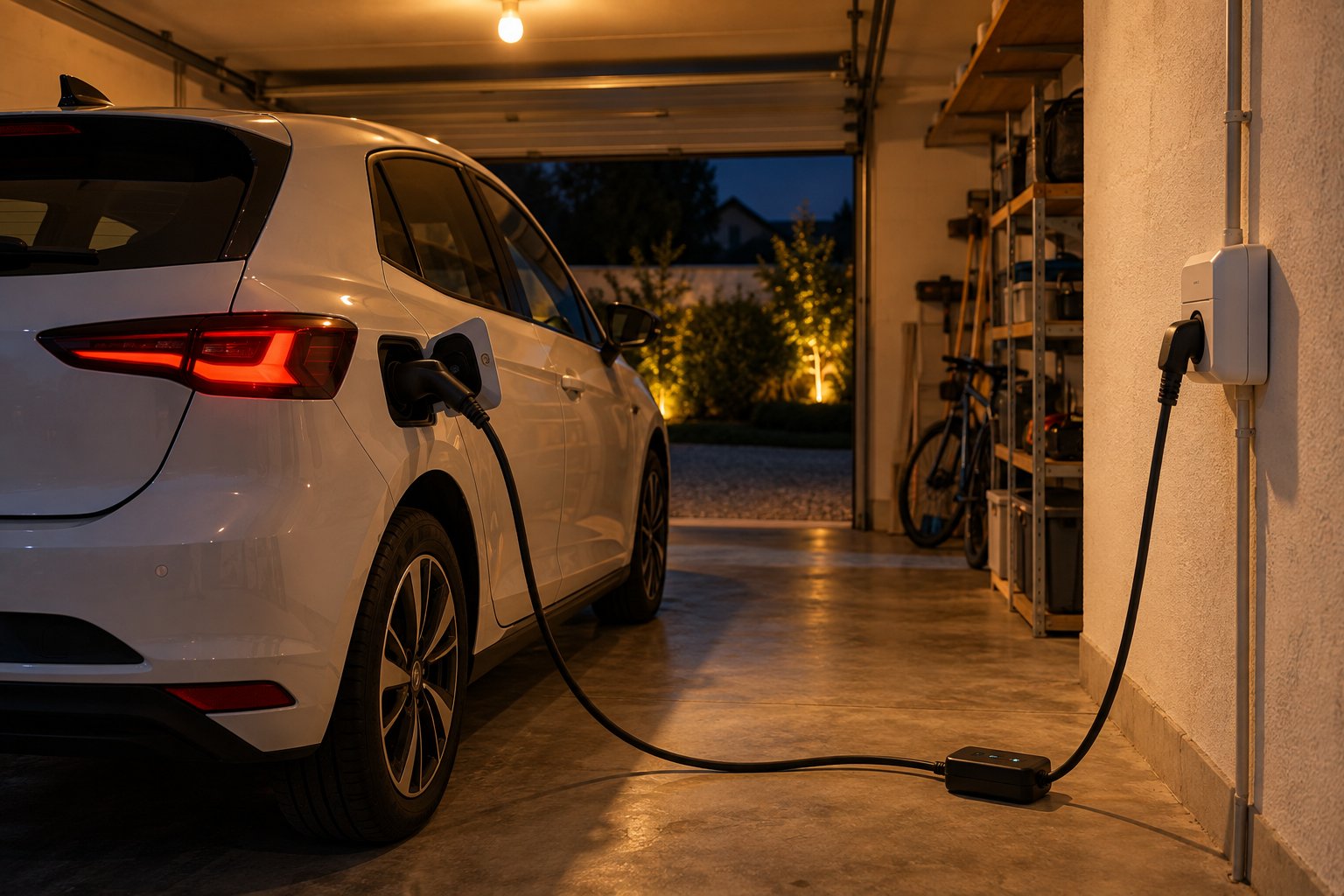
Driver
How long does it take to charge an electric car? UK times by charger, and miles added overnight
How long to charge an electric car in the UK: 3-pin plug, 7 kW home charger, 22 kW and rapid. Tables by battery, miles per hour and miles added overnight.
Driver
EV tariffs explained: off-peak charging windows, prices and how employers should reimburse them
Economy 7, fixed EV tariffs, smart and Agile tariffs compared, with windows, prices and savings, and how employers should repay off-peak charging.
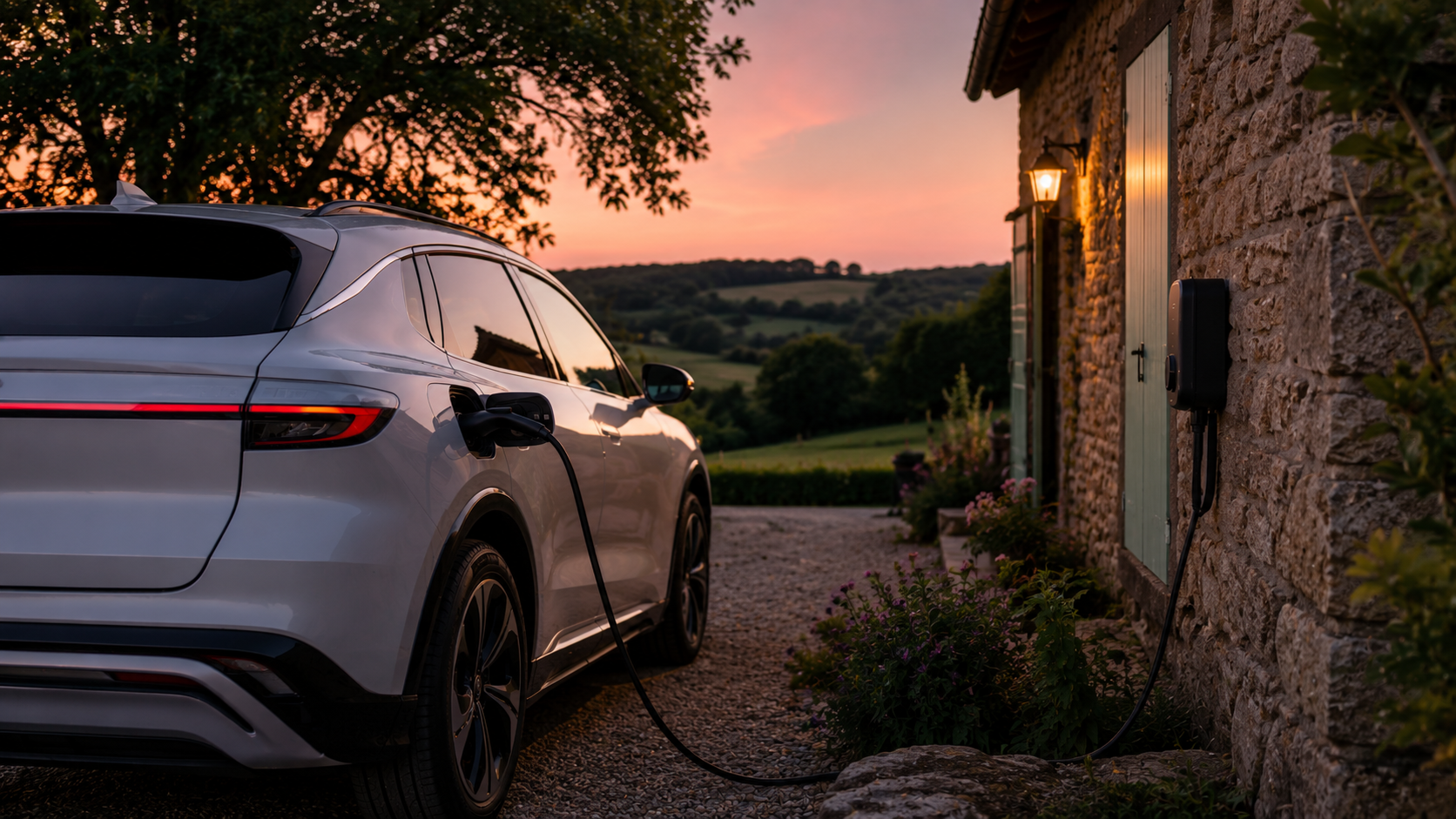
Driver
Charging an electric car at home in the UK: 3-pin plug or wallbox, and how to set it up
3-pin plug, commando socket or 7 kW wallbox? Miles per hour, fuse size, costs, grants, installer rules and EV tariffs for charging an EV at home in the UK.