Charging an electric car at home in the UK: 3-pin plug or wallbox, and how to set it up
3-pin plug, commando socket or 7 kW wallbox? Miles per hour, fuse size, costs, grants, installer rules and EV tariffs for charging an EV at home in the UK.
Aubin Aycaguer, Chief of Staff, Voltaback3 Nov 2026

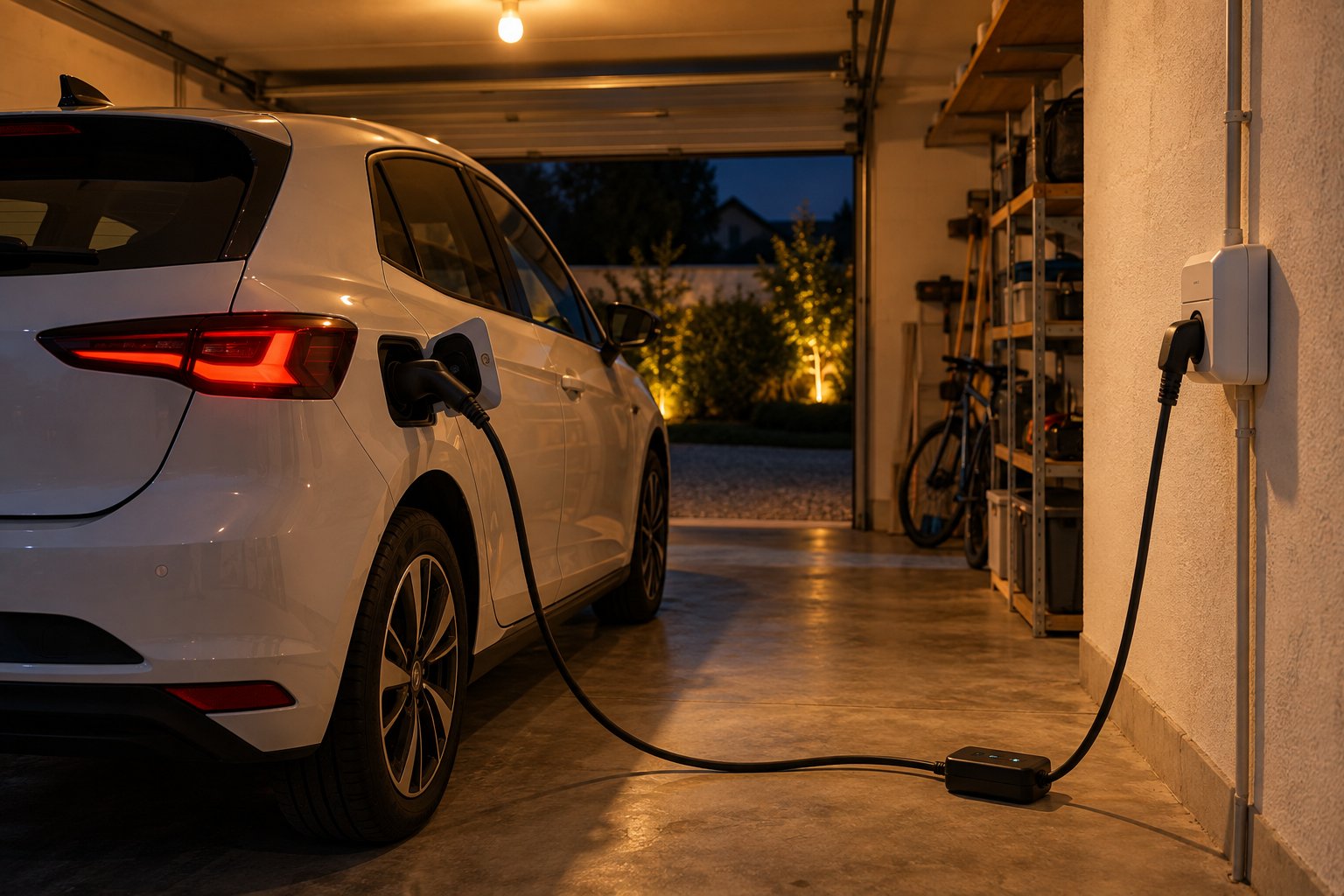
For most UK drivers with off-street parking, the right way to charge an electric car at home is a 7 kW smart wallbox on an EV tariff: it adds about 20 miles of range per hour and fills most cars overnight. A normal 3-pin plug works too, but adds only 6 to 7 miles per hour, so it suits low mileage or occasional use.
This guide gives you a decision path by mileage and parking, explains what your home supply can take, the rules your installer must follow, the grants still open, and what charging at home does to your bill. If you drive a company car, the last section covers how your employer can repay the electricity, which Voltaback automates from the car's own data.
The three ways to charge at home
Option | Power | Miles added per hour (about 3.1 miles/kWh) | Full charge, 60 kWh battery | Typical cost |
|---|---|---|---|---|
3-pin plug (portable "granny" cable) | about 2.3 kW | 6 to 7 | 24 to 28 hours | cable usually supplied or about £200 to £300 |
Commando socket (16 A, blue) | about 3.6 kW | 10 to 11 | about 17 hours | socket fitted by an electrician, plus a compatible cable |
Smart wallbox, single phase | 7 to 7.4 kW | 20 to 22 | 8 to 9 hours | about £800 to £1,200 installed |
Wallbox, three phase | 11 to 22 kW | 30+ (if the car accepts it) | 3 to 6 hours | rare in homes: needs a three-phase supply |
Charging times above are from empty to full. In real life you rarely start from zero: most drivers plug in each night and top up the 20 to 60 miles they used that day.
Sources: Carsa home charging guide, Which? home charging guide.
The 3-pin plug
Every UK home already has one, so it costs nothing to start. The portable cable has a control box that limits the current to about 10 A, to protect a socket that was never designed for hours of continuous load. Use a dedicated outdoor socket in good condition, never an extension lead or a reel, and have an electrician check the circuit if the socket ever feels warm.
The limit is speed: a 10-hour night adds about 65 miles. If your daily driving stays under that, a 3-pin plug can be enough, especially as a second car or a backup.
The commando socket
A blue 16 A industrial socket on its own circuit is the UK's middle ground. It is cheaper than a wallbox and about 50 % faster than a 3-pin plug, but you need a portable charger that accepts a commando plug, and it has no smart functions of its own. The guide to the best charging sockets compares the options, and Voltaback lists what a dedicated socket involves.
The smart wallbox
A wallbox is a fixed charger on its own circuit, tethered (cable attached) or untethered (socket only). It is the comfortable choice: faster, safer for daily use, and able to follow your tariff's cheap hours automatically. Since 30 June 2022, every chargepoint sold for home or workplace use in Great Britain must be smart, under the Electric Vehicles (Smart Charge Points) Regulations 2021.
Do you need a home charger? A decision path
Answer four questions:
- How many miles a day? Under about 40 miles: a 3-pin plug can cope. 40 to 100 miles: a 7 kW wallbox is the sensible choice. Over 100 miles a day: a 7 kW wallbox, plus a plan for public rapid charging on long days.
- Where do you park? A driveway or garage makes a wallbox simple. No off-street parking: look at the on-street options below.
- What tariff are you on? EV tariffs sell a nightly window of four to seven hours. A 7 kW wallbox fits about 130 miles into a six-hour window. A 3-pin plug fits about 40.
- How many EVs in the household? Two EVs on one supply usually need a single charger with load management, or two chargers that share the available power.
In practice, most drivers who can park off-street end up with a 7 kW wallbox within a year, because it makes off-peak charging effortless. For a full breakdown of prices, see the home charger installation cost guide.
What your home supply can take
Single phase, 230 V, and the main fuse
Almost all UK homes have a single-phase 230 V supply. The main fuse, usually 60 A, 80 A or 100 A, sets the total power the home can draw at once. A 7.4 kW wallbox draws 32 A on its own. On a 100 A supply, that leaves plenty of room. On a 60 A supply with an electric shower, an oven and a heat pump running at the same time, it may not.
That is why the installer starts with a maximum demand assessment: the sum of what the home could draw at its busiest, plus the charger.
Load management instead of a supply upgrade
If the numbers are tight, a smart wallbox with load management uses a sensor clamped on the incoming cable. When the house draws a lot, the charger slows down; when the oven goes off, it speeds up again. This usually avoids a costly supply upgrade.
If an upgrade is needed anyway, for example from a 60 A to a 100 A fuse, your installer or you apply to the local Distribution Network Operator (DNO). In many cases the upgrade is free or low cost, but it takes time, so ask early.
Earthing and protection
Many UK homes have a PME earthing arrangement. The wiring regulations (BS 7671) set specific protection for EV chargepoints outdoors, so the installer will either use a charger with built-in open-PEN protection or fit an earth rod. This is part of the installer's job, but it explains why two quotes for the "same" charger can differ.
Installation rules: who can install, and what is notified
- Part P of the Building Regulations (England and Wales): a new circuit in a home is notifiable work. Use an electrician registered with a competent person scheme, who self-certifies the work, or notify building control. You get a certificate for your records.
- DNO notification: the installer tells the local network operator that a chargepoint has been connected.
- Smart Charge Points Regulations 2021: the charger must come with pre-set default charging hours outside peak times (8 am to 11 am and 4 pm to 10 pm on weekdays), which you can accept or change at first use, plus a randomised delay function.
- Grants: only installers authorised by the Office for Zero Emission Vehicles (OZEV) can claim the grant on your behalf.
- Planning: a wall-mounted charger is usually permitted development, but check first if you live in a listed building or a conservation area.
Can you install a wallbox yourself? Plugging in a portable cable, yes. Installing a new circuit and a fixed charger, no: it is notifiable electrical work, it affects your home insurance, and grants require an authorised installer.
Sources: Smart charge point regulations, gov.uk, Electric Vehicles (Smart Charge Points) Regulations 2021, Building regulations approval, gov.uk.
Grants still available in 2026 to 2027
OZEV extended its chargepoint grants for a final year, to 31 March 2027, at up to £500:
- Renters and flat owners with private off-street parking: up to £500 towards a home chargepoint.
- Households with only on-street parking: up to £500 towards a cross-pavement solution such as a charging channel, with your council's consent.
- Landlords: up to £500 per socket, for up to 200 sockets.
- Employers: the Workplace Charging Scheme pays up to £500 per socket, for up to 40 sockets.
Homeowners in a house with a driveway are no longer eligible for a home grant.
Source: Electric vehicle chargepoint grants, gov.uk.
Flats, renters and on-street parking
Renters need the landlord's written consent before any installation. A portable or untethered wallbox you can take with you when you move is often the easiest to negotiate.
Leaseholders in a block of flats need consent from the freeholder or management company, and often a shared solution for the car park, sized for several residents with load management. The guide to installing a charger in a shared building explains how to approach the building owner and what a shared installation looks like.
On-street parking: never run a cable across the pavement on its own, as it is a trip hazard and councils can take action. Look for:
- council-approved cross-pavement channels (grant-eligible);
- lamp-post and kerbside chargers, which many councils are installing with the government's Local EV Infrastructure (LEVI) funding;
- workplace charging, if your employer offers it.
Pair your charger with an EV tariff
The hardware decides how fast you charge; the tariff decides how cheap each mile is.
Under the Ofgem price cap for October to December 2026, a standard variable tariff costs 26.32p per kWh on average. EV and time-of-use tariffs sell a nightly window at roughly 7p to 9p per kWh. At about 3.1 miles per kWh:
Tariff | Price per kWh | Pence per mile | Cost of 8,000 miles a year |
|---|---|---|---|
Standard variable (price cap) | 26.32p | about 8.4p | about £674 |
EV tariff, off-peak window | about 7p | about 2.2p | about £179 |
Public rapid charger | about 79p | about 25p | about £2,022 |
A smart wallbox follows your off-peak window automatically, and most cars can also schedule charging from their own app, even on a 3-pin plug. Most EV tariffs require a smart meter. The EV tariffs guide compares the types of tariff and the windows.
From 1 October 2026 to 31 March 2027, VAT on domestic electricity in Great Britain is 0 % instead of 5 %, which makes home charging slightly cheaper still. Public chargers keep 20 % VAT.
Sources: Ofgem price cap, October to December 2026, Zapmap charging price index, Revenue and Customs Brief 10 (2026).
Do you need a smart meter?
Not to charge: any home can charge an EV on any meter. A smart meter is needed for most time-of-use tariffs, which is where the savings are. If you do not have one yet, it is installed free by your supplier. The guide to charging without a smart meter covers Economy 7 and the other options.
Choosing the wallbox: five checks
- The power your car accepts. Most cars take 7 kW on AC from a single-phase supply. Paying for 22 kW makes no sense without three-phase power and a car that accepts it.
- Tethered or untethered. Tethered is more convenient day to day. Untethered looks tidier and works with any connector, but you handle the cable each time.
- Load management. Essential on a 60 A or 80 A supply, or with two EVs.
- Tariff integration. Some suppliers' smart tariffs control compatible chargers or cars directly. Check the list before you buy.
- App and data. Useful to see your sessions. For a company car, it is not required for reimbursement: the car's own data does the job.
Get at least two quotes, ask each installer what is included (cable run length, protection device, earth rod, wall drilling) and ask for the Part P certificate and the DNO notification to be included.
Day-to-day habits that save money and battery
- Plug in every night rather than waiting for a low battery. Short, regular top-ups in the cheap window cost less than one long charge that spills into peak hours.
- Set a daily charge limit, often 80 %, if your manufacturer recommends it, and charge to 100 % only before long trips.
- Precondition the cabin while plugged in on cold mornings: the heating then runs on cheap home electricity instead of the battery.
- Check your sessions once a month in the car or wallbox app. A sudden jump in kWh per mile usually means short winter trips, tyre pressure or a charging schedule that slipped out of the off-peak window.
Company car: do you need a wallbox, and who pays the electricity?
You do not need a wallbox to be reimbursed. For a company car, HMRC allows the employer to repay all the electricity used to charge it at home, business and private miles, tax and NIC free (EIM23900, s.239(2) ITEPA 2003). A chargepoint installed at your home by your employer for the company car is not a taxable benefit either.
What the employer needs is a reliable figure for the kWh that went into the car. Voltaback reads it from the car itself, for more than 48 brands, so it works with a 3-pin plug, a commando socket or any wallbox. Each session is valued at the driver's tariff at the time of charging: Voltaback relies on the home's MID-certified meter, not on a standalone cable meter. The company receives a monthly export ready to import into payroll. The company never receives the car's location.
Some employers pay HMRC's Advisory Electricity Rate instead: 7p per business mile for home charging since 1 September 2026, with no payment for private miles. The driver's guide to charging a company car at home compares both methods in pounds. If your employer funds the charger, Voltaback can also help you get installer quotes; it does not install chargers itself.
Sources: EIM23900, HMRC, Advisory fuel rates, HMRC.
Charging an electric car at home: your questions
Yes. A 3-pin plug with the car's portable cable delivers about 2.3 kW, which adds 6 to 7 miles of range per hour. Use a dedicated outdoor socket in good condition, never an extension lead, and have an electrician check the circuit if you charge every night.
Not always. If you drive under about 40 miles a day, a 3-pin plug overnight can be enough. Above that, or to make the most of a short off-peak window, a 7 kW wallbox is much more practical: it adds about 20 miles per hour.
A 7 kW smart wallbox typically costs about £800 to £1,200 installed, depending on the charger, the cable run and the protection needed. Renters and flat owners with off-street parking can get up to £500 off through the OZEV grant until 31 March 2027.
Usually no planning permission is needed for a wall-mounted charger, unless your home is listed or in a conservation area. Renters need the landlord's consent and leaseholders the freeholder's. The installation itself is notifiable under Part P and the installer notifies the network operator.
No, not a fixed wallbox. It needs a new circuit, which is notifiable electrical work under Part P, specific earthing protection and a DNO notification. Grants are only paid through OZEV-authorised installers.
7 kW is enough for nearly every home. Most UK homes are single phase, which caps a wallbox at about 7.4 kW, and many cars only accept 7 or 11 kW on AC anyway. A 22 kW charger needs a three-phase supply, which few homes have.
You do not have to, but you should. An EV tariff with a cheap night window at around 7p to 9p per kWh cuts the cost of a mile by roughly two thirds compared with the price cap rate of 26.32p. Most EV tariffs need a smart meter.
Home charging for your company fleet
Home charging is the cheapest and simplest way to run an electric car, as long as the driver is not left out of pocket. For company cars, the missing piece is usually not the charger but a fair, low-effort way to repay the electricity.
Voltaback measures each home session from the car, values it at the driver's real tariff and gives payroll one export a month, with no hardware to fit and no location shared. Talk to our team to see how it would work for your drivers.
Recommended articles
Driver
How long does it take to charge an electric car? UK times by charger, and miles added overnight
How long to charge an electric car in the UK: 3-pin plug, 7 kW home charger, 22 kW and rapid. Tables by battery, miles per hour and miles added overnight.

Driver
EV tariffs explained: off-peak charging windows, prices and how employers should reimburse them
Economy 7, fixed EV tariffs, smart and Agile tariffs compared, with windows, prices and savings, and how employers should repay off-peak charging.

Driver
Charging your company car at home: can you claim the electricity back from your employer?
Yes, your employer can repay all the electricity you use to charge a company EV at home, private miles included, tax and NIC free. How it works in 2026.