Charging your company car at home in Switzerland and getting reimbursed fairly
Charging a company car at home in Switzerland: who pays for the electricity, what you should get back by canton, T23 socket or wallbox, low tariff.
Aubin Aycaguer, Chief of Staff, Voltaback3 Nov 2026

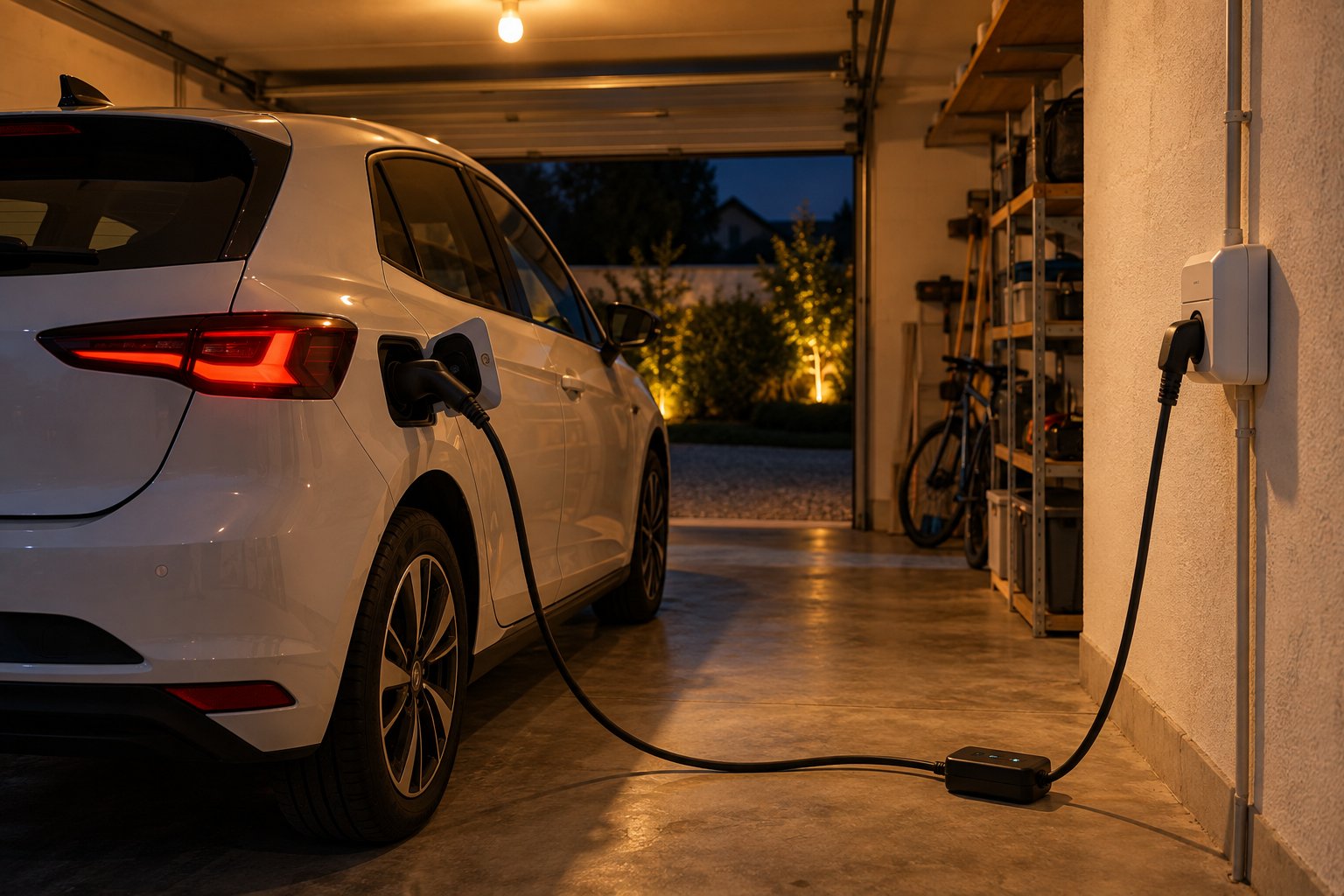
Yes, you can charge your electric company car at home in Switzerland, and the electricity is in principle your employer's cost. The 0.9 % private-use charge on your Swiss salary certificate already assumes that the company pays all the car's costs, everyday energy included.
This guide is for company car drivers, including those who have recently moved to Switzerland. It explains what you need at home, how to charge cheaply on the low tariff, who pays for what, how much you should get back depending on your canton, how your charging can be measured without installing anything (the way Voltaback does it for more than 200 companies), what your employer sees, and what to say to HR if your company does not reimburse yet.
Why charging at home is the easiest option
A company car typically spends twelve hours or more a day in your parking space or garage at home. Plugging in when you get back and leaving with a full battery in the morning removes almost every detour to a public charger.
It is also the cheapest energy your car will use. The 2026 Swiss median for a standard household is 27.7 Rp./kWh (centimes per kWh), and about 25 Rp. in Zurich and Geneva. Rapid charging on the public network costs considerably more per kWh. Every charge at home saves your employer money, which is a good argument when you ask for an exact reimbursement. Source: ElCom (Swiss Federal Electricity Commission), electricity prices by municipality.
What you need at home
There are three realistic setups, and all work with a company car. Note that Swiss sockets differ from those elsewhere in Europe.
Setup | Typical power | Range added per hour (approx.) | Suits |
|---|---|---|---|
Standard Swiss T13 socket with the car's cable | about 2 kW | about 10 km | Emergencies, plug-in hybrids, very short trips |
Dedicated T23 socket (16 A) | up to about 3.7 kW | about 20 km | Up to 150 to 200 km a day with one night's charge |
Wallbox, or three-phase CEE socket with a mobile charger | 11 kW | about 60 km | High-mileage drivers, large batteries |

The ordinary T13 socket is not designed to deliver current for hours, night after night: keep it for emergencies. For daily use, a dedicated T23 socket on its own circuit is enough for most drivers. Charging times by battery size are covered in our article on how long it takes to charge an electric car.
Who can install what
Any new socket or wallbox must be installed by a licensed electrician, under the Low-Voltage Installations Ordinance (NIV / OIBT). The electrician notifies the grid operator with an installation notice and then hands over a safety certificate (Sicherheitsnachweis / rapport de sécurité). Voltaback does not install chargers, but it can help you get quotes from installers.
Renting, or owning a flat in a condominium
- Tenants: you need the landlord's written consent for any alteration to the rented property (Art. 260a of the Swiss Code of Obligations). There is no legal "right to charge" yet.
- Condominium owners (Stockwerkeigentum / PPE): a charging station is usually a "useful" alteration that needs a majority of co-owners who also hold the larger share of the property (Art. 647d of the Swiss Civil Code), unless the condominium regulations say otherwise.
- What is changing: in June 2025 Parliament adopted motion 23.3936 on charging electric cars in rented and condominium buildings. The Federal Council consulted until 12 October 2026 on an amendment to the Energy Act under which owners of residential buildings could be required to put in the basic installation when a tenant or co-owner asks for it. It is not in force yet.
Sources: Swiss Federal Office of Energy, guide for condominiums, guide for tenants and Swiss Parliament, vote of 11 June 2025. For more, read our article on charging in a condominium.
Charge smart: use the low tariff
Most Swiss grid operators offer a two-rate tariff: a high tariff (Hochtarif / tarif haut) during the day and a low tariff (Niedertarif / tarif bas) at night and often at weekends. The hours are set by your operator (ewz, EKZ, SIG, Romande Energie, WWZ, IWB...), for example 22:00 to 06:00, and are shown on your bill.

Set the charging start time in your car's app or your wallbox app so that it begins when the low tariff starts. You get a full battery in the morning, at the best price, without thinking about it. The gap between high and low tariff, and the pitfalls, are explained in our article on off-peak charging.
If you live in a self-consumption group (ZEV / RCP) or have your own solar panels, your real kWh price is often even lower. A fair reimbursement has to reflect that.
Who pays for your company car's electricity?
Your employer. The official guide to the salary certificate is clear: the private-use charge of 0.9 % of the purchase price per month applies when the employer bears all costs and you only pay fuel or energy for longer private trips at weekends or on holiday (margin note 21). Electricity for your commute and normal private use is therefore the company's cost.
What if you pay it yourself? Your private-use charge does not go down. The same guide states that bearing only the costs of charging electric vehicles is not enough to waive the private-use charge (margin note 23). Without reimbursement, you pay twice: the private-use charge on your salary certificate and the electricity on your bill. Source: ESTV (Federal Tax Administration), salary certificate guide 2026, also on the ESTV salary certificate page.
How the private-use charge is calculated is explained in our article on the private-use charge for an electric company car.
How much you should get back, canton by canton
Your employer has two options. It can pay a lump sum of up to CHF 60.– a month, as set out in the model expense regulations of the Swiss Tax Conference (SSK/CSI). Or it can reimburse your actual costs: the kWh charged for the car multiplied by your tariff. Source: SSK/CSI model expense regulations 2026.
Example for 15'000 km a year, with 18 kWh/100 km and about 10 % charging losses, or about 250 kWh a month at the meter:
Canton of residence | 2026 median (ElCom) | Real cost per month | With the CHF 60.– lump sum |
|---|---|---|---|
Zug | 21.9 Rp./kWh | about CHF 55.– | you get CHF 5.– too much |
Zurich | 24.8 Rp./kWh | about CHF 62.– | you are CHF 2.– short |
Geneva | 24.9 Rp./kWh | about CHF 62.– | you are CHF 2.– short |
Swiss median | 27.7 Rp./kWh | about CHF 69.– | you are CHF 9.– short |
Vaud | 30.4 Rp./kWh | about CHF 76.– | you are CHF 16.– short |
Basel-Stadt | 33.2 Rp./kWh | about CHF 83.– | you are CHF 23.– short |
At 30'000 km a year from Lausanne or Basel, your real cost is around CHF 1'800.– to 2'000.– a year: with the lump sum, you pay more than CHF 1'000.– of it yourself. These medians are averages for a standard household: your actual price depends on your municipality, your grid operator and when you charge. Our article on the cost of charging an electric car at home walks through the calculation.
How your charging is measured, with nothing to install
To be reimbursed at actual cost, someone has to know how many kWh went into the car, not into the cooker or the water heater. With Voltaback you have nothing to install and nothing to read:
- Your car is connected to the platform, which is 100 % software and works with more than 48 brands. No box, no compulsory smart wallbox: your current socket or wallbox is enough.
- Voltaback relies on the home's MID-certified meter, not on a standalone cable meter. The measurement has been audited by an independent third party, with a relative error of 1.22 %.
- Your real tariff is applied: high or low according to the time of charging, based on your bill.
- Everything is in the app: charging sessions, kWh, monthly amount. Your employer receives a payroll-ready monthly statement.
See the Voltaback driver app and what it changes for you on the driver page.
Your privacy: what your employer sees, and what it does not
In Switzerland, an employer may process data about you only insofar as it concerns your suitability for the job or is needed to perform the employment contract (Art. 328b of the Code of Obligations). The revised Federal Act on Data Protection (nFADP / nDSG / nLPD), in force since 1 September 2023, strengthens these principles under the supervision of the Federal Data Protection and Information Commissioner (FDPIC / EDÖB). Source: Art. 328b CO on Fedlex.
What your employer sees | What it never sees |
|---|---|
The kWh charged for the car | Where you are or where you go |
The amount reimbursed each month | Your weekend trips |
The car's mileage | The rest of your household's consumption |
With Voltaback, the company never receives drivers' geolocation. The platform has been ISO 27001 certified since 2 December 2025.
Tax and social security: what stays the same for you
An expense reimbursement is not salary. Documented actual costs, or an accepted lump sum of up to CHF 60.– a month, are neither taxable income nor wages subject to AHV/AVS contributions (old-age and survivors' insurance). On your salary certificate, the lump sum appears under item 13.2.3, and actual costs under item 13.1.2 if your employer has no approved expense regulations.
Your 0.9 % private-use charge does not change either: it already covers everyday energy. Only a lump sum above CHF 60.– a month is a problem, because the excess is treated as salary. If you are taxed at source, for example as a cross-border commuter or B-permit holder, approved lump-sum expenses are not subject to withholding tax.
Your company does not reimburse yet? Talk to HR
Many Swiss companies have simply not updated their expense regulations yet. Here is how to raise it:
- Put a figure on it: your monthly kWh (shown in your car's app) multiplied by the kWh price on your bill.
- Quote the rule: the 0.9 % private-use charge assumes the employer pays for the energy, and paying it yourself does not reduce it (salary certificate guide, margin notes 21 and 23).
- Suggest a solution: a lump sum of up to CHF 60.– a month or, better, reimbursement of measured actual costs, with no expense claims.
- Show what the company gains: every kWh charged at home is cheaper than a kWh at a public rapid charger.
You can forward the page on home charging reimbursement at real cost to your HR or fleet manager, or suggest they contact Voltaback.
Frequently asked questions about charging a company car at home in Switzerland
Yes, on a dedicated T23 socket or a wallbox installed by a licensed electrician. The standard T13 socket is only for emergencies. If you rent, you need your landlord's written consent.
Your employer. The 0.9 % private-use charge assumes the employer bears all of the car's costs; you normally pay only for energy used on longer private trips at weekends or on holiday.
Either a lump sum of up to CHF 60.– a month or your actual costs, meaning the kWh charged multiplied by your tariff. At 15'000 km a year, actual costs range from about CHF 55.– a month in Zug to about CHF 83.– in Basel-Stadt.
No. The official guide to the salary certificate states that bearing only the charging costs is not enough to waive the 0.9 % private-use charge.
No, if it matches your documented actual costs or an accepted lump sum of up to CHF 60.– a month. It is subject neither to income tax nor to AHV/AVS contributions. Only a higher lump sum is treated as salary for the excess.
No, with Voltaback the company never receives geolocation. It only sees the kWh charged for the car, the mileage and the amount reimbursed.
Get paid back for every kWh
Charging at home is easier for you and cheaper for your company, as long as the reimbursement is exact. If your employer is looking for a way to do it, they can contact the Voltaback team.
Recommended articles
Driver
EV charging time in Switzerland: table, calculation and km recovered overnight
How long to charge an electric car in Switzerland on a T13, T23, CEE socket, 11 kW wallbox or rapid charger: formula, table and km recovered overnight.

Driver
Off-peak EV charging in Switzerland: low tariff hours, prices and scheduling
Low tariff hours in Switzerland by network operator, price gap, annual savings, how to schedule charging, and dynamic electricity tariffs since 2026.

Driver
How much does it cost to charge an electric car in Switzerland? Home, work and public
What it costs to charge an electric car in Switzerland: a full charge, per 100 km, per month and canton, at home, at work and on public rapid chargers.