Charging station or socket: what do you really need?
Charging station or socket: what do you really need?

Voltaback adapts to your charging installation
T13, T23, CEE socket or charging station, all brands. Nothing to install, nothing to configure.

Voltaback measures charging even on a standard T13 household socket. Best kept for occasional top-ups.

T23 or CEE 16 A socket (3.7 kW). The most cost-effective choice for daily use.

7, 11 or 22 kW wallbox. Voltaback works with no configuration, whatever the brand.

Socket or charging station in a condominium, Voltaback works whatever the installation.

Solar or wind power, with reimbursement based on your electricity tariff.

Upload your electricity bill directly on the platform
Frequently asked questions
FAQ: T23 socket or charging station?
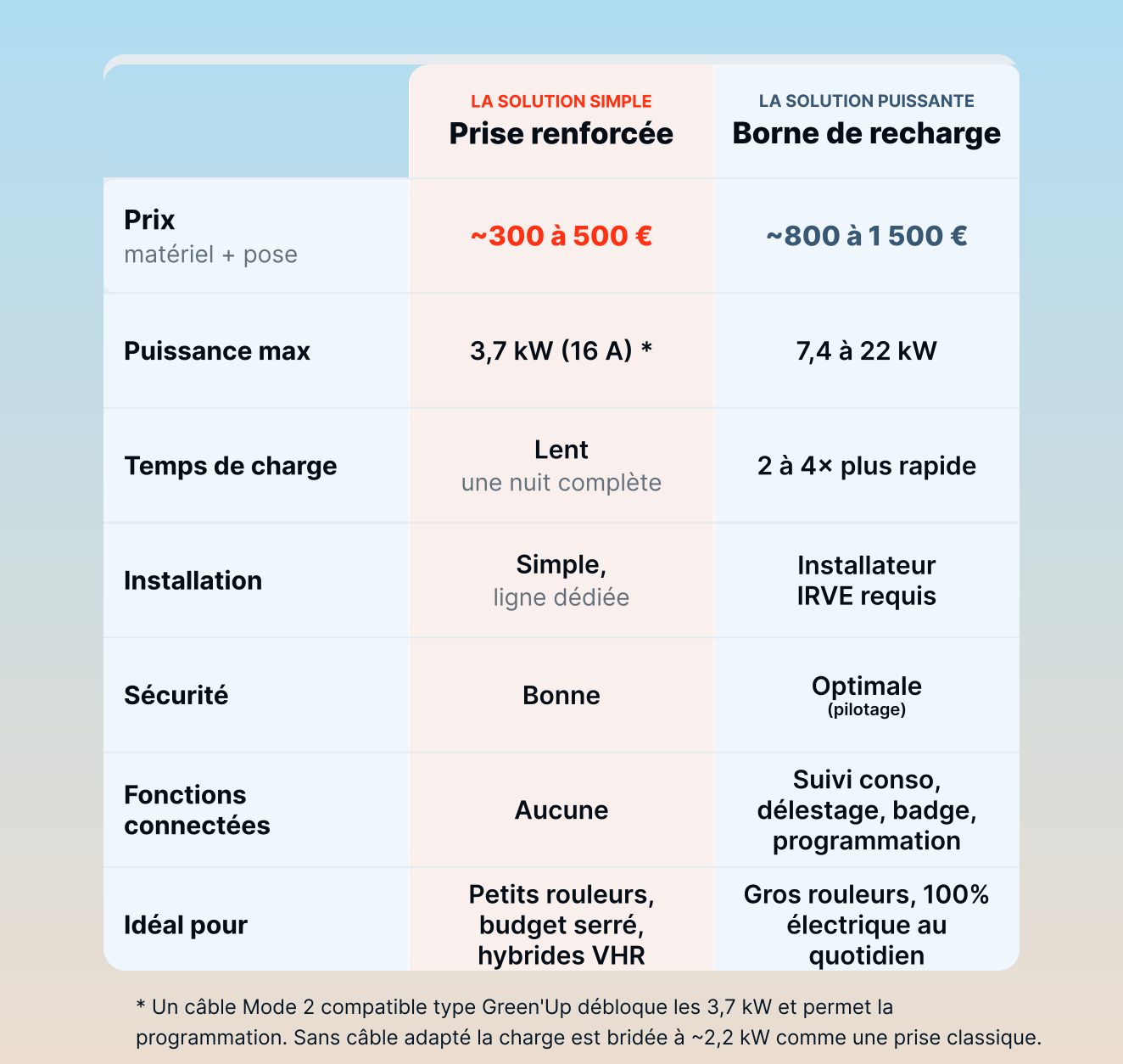
For many drivers, a simple T23 or CEE socket is enough: if you come home every evening and charge overnight, even 3.7 kW easily covers a day of driving. A charging station becomes useful if you drive a lot, have a big battery to fill often, or want to plug in 2 vehicles. In short: high mileage or need for speed → charging station; normal daily use → a T23 or CEE socket does the job for much less.
The risk is not the car but the socket: a standard T13 household socket is not designed to deliver 2 kW for 8 hours straight, and it can heat up, especially on an old installation or with an extension lead. That is why cables limit it to 8 or 10 A. A T23 or CEE socket, or a charging station, on a dedicated circuit with the right protection removes this risk. The real advice: avoid extension leads and have a dedicated circuit installed by a licensed electrical installer.
Yes, on two conditions. It delivers 3.7 kW (16 A) instead of 1.8 to 2.3 kW, and above all it is designed for long charging sessions in safety. For that, it needs a dedicated circuit with the right protection, AND a Mode 2 cable with a T23 or CEE plug, set to 16 A. With a cable fitted with a T13 plug, you charge as you would on a normal socket and the extra cost is wasted. You will find the guide to the right cable in the resources on our site.
Rarely. In Switzerland, an 11 kW three-phase charging station is the usual choice and fills the battery overnight. 22 kW needs a more powerful grid connection, and above all many cars cap AC charging at 7 or 11 kW, so paying for 22 kW does not make it any faster. The consensus: choose 11 kW unless you have a very specific need.
A T23 or CEE socket costs much less than a charging station, whose installation costs around CHF 3'000 in the best case. As for support in 2026: no federal support; some cantons and municipalities subsidise mainly charging stations and the pre-equipment of shared car parks (for example Zurich, Geneva, Ticino, Lucerne). The real payback comes from home charging, much cheaper than public charging, and even more so if your kWh are reimbursed.
Yes, almost always. A PHEV has a small battery (often 10 to 20 kWh) that a T23 or CEE socket fully charges overnight. Installing a charging station for a hybrid is usually oversized: keep your budget for something else.
No particular installation is required. Whether you charge on a T13, T23 or CEE socket or a charging station, Voltaback measures your actual kWh and generates documentation compliant with the salary certificate (Lohnausweis), with no box or smart charging station to install. You choose the installation that suits you, Voltaback takes care of reimbursement at real cost.
Still not sure whether to install a T23 or CEE socket or a charging station? Here is the test to find out in 2 min!