Cross-border worker with a Luxembourg company car: charge at home and get reimbursed fairly
Cross-border worker with an electric company car in Luxembourg: who pays for home charging, which kWh price applies, benefit in kind and the 34-day rule.
Aubin Aycaguer, Chief of Staff, VoltabackNov 4, 2026

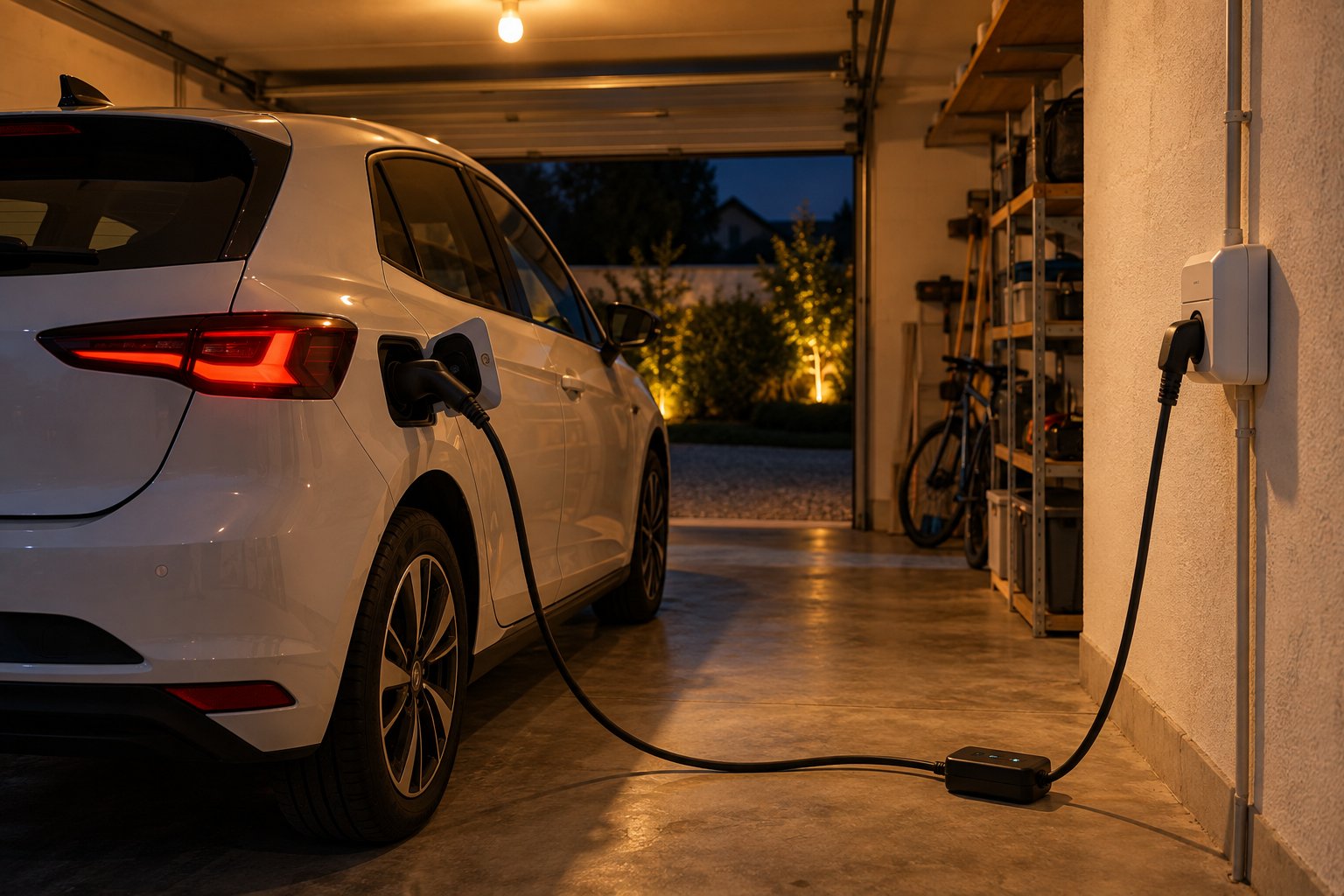
Yes, you can charge your electric company car at home, even if you live in Belgium, Germany or France, and your Luxembourg employer should pay for that electricity. The fair way to be reimbursed is simple: every kWh actually charged into the car, at the price of your own electricity contract, wherever you live.
This guide is for company car drivers, and above all for cross-border workers. It covers what you need at home, what a charged kWh really costs in your country of residence, who pays for what, why your benefit in kind does not change, how your charging can be measured without installing anything (this is what Voltaback does for more than 200 companies) and what your employer can and cannot see.
Cross-border workers: half of Luxembourg's employees
On 31 March 2026, Luxembourg had 228,352 cross-border workers out of 464,049 employees, or 49 %. A Luxembourg company car very often spends the night on the other side of the border, plugged into a Belgian, German or French grid.
That is what makes your situation different. You are paid and taxed in Luxembourg, but your electricity is billed by a supplier in your country of residence, at its prices and under its rules. A reimbursement designed only for Luxembourg residents may not cover what you actually pay.
Source: IGSS, employment dashboard, March 2026.
Why charging at home is the easiest option
Your car usually sits outside your home for twelve hours or more a day. Plugging in in the evening and leaving with a full battery removes almost every stop at a public charger, which are often busy at peak times near the border crossings.
It is also the cheapest electricity your car will ever use. Public charging commonly costs 0.50 € per kWh or more, two to three times the price of a kWh charged at home. Every night on your own supply saves your employer money, which is a strong argument for asking to be reimbursed accurately.
What do you need at home?
There are three options, and all of them work with a company car.
Charging point | Typical power | Range added per hour (approx.) | Best for |
|---|---|---|---|
Household socket with the car's portable cable | approx. 2 kW | approx. 10 km | Emergencies, very short trips |
Dedicated heavy-duty socket (16 A) | up to approx. 3.7 kW | approx. 20 km | Most commutes |
Three-phase wallbox | 11 kW | approx. 60 km | High-mileage drivers, large batteries |

Ten hours on a heavy-duty socket add about 37 kWh, or roughly 200 km for a car using 18 kWh per 100 km. For a cross-border commute of 60 to 120 km a day, that is plenty. Charging times by battery size are covered in our article on how long it takes to charge an electric car.
Installation rules depend on your country of residence
Any new dedicated socket or wallbox must be installed by a qualified electrician, under the rules of the country where your home is:
- In Luxembourg: an approved electrician, plus a prior request to the grid operator (usually Creos) for a charger of 7 kW or more on three-phase, or above 4.6 kW on single-phase. Source: Creos, charging your car.
- In Belgium, Germany or France: the standards, grid operator and any grants of your own country apply. Ask a local electrician.
Voltaback does not install chargers, but can help you get quotes from installers.
What does a kWh charged at home really cost?
To be reimbursed fairly, look at the price of one extra kWh: energy, per-kWh network fee, per-kWh taxes and VAT. Your monthly fixed charges do not change because you charge a car. The average price on your bill, fixed charges included, is therefore the wrong figure.
Country of residence | Price of a charged kWh (2026 order of magnitude, incl. VAT) | Cost of 100 km (18 kWh) |
|---|---|---|
Luxembourg, dual-rate offer, at night | approx. 0.19 € | approx. 3.40 € |
Luxembourg, above the reference power | approx. 0.27 € | approx. 4.90 € |
Belgium, dual-rate meter, at night | approx. 0.24 € | approx. 4.30 € |
Belgium, single rate | approx. 0.33 € | approx. 5.95 € |
Germany | approx. 0.32 € | approx. 5.75 € |
In Luxembourg, a kWh charged at night on a dual-rate offer costs about 0.19 € including taxes, barely less than during the day (about 0.20 €). Creos's volumetric network fee is 0.051 € per kWh excluding VAT, and VAT on electricity is 8 %. If charging takes you above your reference power, each kWh above it costs an extra 0.0765 € excluding VAT. Source: Creos, guide to the tariff structure.
In Germany, the 0.32 € order of magnitude applies to households using 5,000 to 15,000 kWh a year, typical for a home that charges a car. Source: Destatis, average electricity prices.
Why a single Luxembourg price does not work for you
Some employers and leasing companies reimburse at one average price per country. Take a cross-border worker who drives 20,000 km a year and charges about 4,000 kWh at the home meter, charging losses included:
- reimbursed at the Luxembourg night price (0.19 €): about 760 € a year;
- living in Belgium with a dual-rate meter (0.24 €), he pays about 960 €, so 200 € is missing;
- living in Germany (0.32 €), he pays about 1,280 €, so 520 € is missing.
Only reimbursement at the real price of your contract is neutral, for you and for the company. To choose the right time slot, read our article on off-peak charging, and for the full cost picture, our guide to the cost of charging at home.
Charging cheaply in your country of residence
Your employer reimburses the real price. Charging cheaply still pays off: the reimbursement stays lower for everyone, and your household contract benefits too. The levers differ by country:
- Luxembourg: day and night are close on a dual-rate offer. The main lever is staying below your reference power, by charging at limited power across the night. Dynamic tariffs with a Smarty meter follow the hourly market price.
- Belgium: with a dual-rate meter, the night rate (at night and, depending on the grid operator, at weekends) is clearly cheaper than the day rate. A timer in the car or on the wallbox puts charging into that window automatically.
- Germany: many suppliers offer EV tariffs or dynamic tariffs. New wallboxes are also subject to rules on control by the grid operator, which can come with a reduced network fee. Ask your supplier and grid operator what applies to your connection.
One point matters for reimbursement: if your contract has two prices or a dynamic price, the measurement has to know when you charged. Measurement from vehicle data records the date and time of every session and can apply the right price.
Who pays for your company car's electricity?
Your employer. In Luxembourg, private use of a company car is taxed through a monthly flat-rate benefit in kind, and that flat rate covers the car's running costs, just like fuel for a combustion car.
No Luxembourg text deals specifically with charging a company car at home, and there is no official flat rate per kWh. In practice, on the reading of the Grand-Ducal Regulation of 23 December 2016 shared by many practitioners, electricity reimbursed at the real cost of the kWh actually charged into the car stays within the flat-rate benefit. An unjustified monthly lump sum, or an amount above the real cost, may instead be treated as salary. Your employer would do well to have its approach confirmed by its fiduciary.
Sources: Grand-Ducal Regulation of 23 December 2016, coordinated text, Guichet.lu, company cars.
Your benefit in kind stays the same
Reimbursing your charging does not change your benefit in kind. For a fully electric car it is 0.5 % of the list price per month (up to 18 kWh per 100 km under WLTP) or 0.6 % for less efficient models, against 2 % for combustion and hybrid cars registered since 2025. These rates apply to contracts signed by 31 December 2026; a draft regulation plans to extend them to 2030. More detail in our article on the benefit in kind of an electric company car.
Example: a 50,000 € electric car at 16 kWh per 100 km gives a benefit of 250 € a month. Whether you charge at home, at the office or on the road, that amount does not change. Source: Klima-Agence, benefits in kind for company cars.
Keep the 34-day rule in mind
As a cross-border worker, your salary, benefit in kind included, is taxed in Luxembourg for the days you work in Luxembourg. The tax treaties allow residents of Belgium, Germany and France 34 days a year of work outside Luxembourg (home working, training, business trips). For Germany this threshold has applied since 1 January 2024, up from 19 days. Beyond it, the share linked to days worked in your country of residence becomes taxable there.
Charging at home has nothing to do with this count: only working days outside Luxembourg matter.
Do not confuse the tax threshold with the social security threshold. You stay insured in Luxembourg as long as you work less than 25 % of your time in your country of residence; under the European framework agreement on cross-border telework, which Belgium, Germany and France have signed, up to just under 50 % is possible at the employer's request. The two thresholds are independent of each other. Sources: KPMG Luxembourg, treaty with Germany, Frontaliers Grand Est, home working.
Living in Belgium: the car stays registered in Luxembourg
If you live in Belgium, you do not have to register in Belgium the Luxembourg car your employer provides. Keep your Luxembourg employment contract to hand in case of a roadside check. Source: Guichet.lu, Belgian residents with a company car.
A plug-in hybrid as a company car
The same principle applies to a plug-in hybrid: electricity charged at home is reimbursed, there are just fewer kWh because the battery is smaller. The benefit in kind for a first registration from 2025, however, is 2 % of the list price per month, four times that of an electric car. Charging still pays off for everyone: every kilometre driven on electricity costs the company far less than a kilometre on petrol.
How your charging is measured without installing anything
To reimburse you at real cost, your employer needs two things: the kWh charged into the car and the price of your contract. No smart charger and no box are needed.
Voltaback collects charging data directly from the car manufacturer, across more than 48 brands. Each home charging session is recognised, charging losses are taken into account and your tariff is applied. Voltaback relies on the home's MID-certified meter, not on a standalone cable meter. The method has been audited by an independent third party, with a relative error of 1.22 %.
In practice, you connect your car and your electricity contract in the driver app in a few minutes. The reimbursement then arrives every month, with no expense claim and no meter photos. Everything for drivers is summed up on the driver page.
Getting started in five steps
- Check your charging point: a dedicated socket on a protected circuit, or a wallbox, installed under your country's rules.
- Have your electricity bill to hand: you need the price per kWh (both prices if you have two rates), not the monthly instalment.
- Install the app and connect the car: a few minutes, with no device in the car.
- Enter your electricity contract: only home charging sessions are reimbursed, at that contract's price; sessions at the office or on the road are not included.
- Report changes: new tariff, house move or change of supplier, so the new price applies from that day.
Charging at the office and on the road
If your employer offers charging in the company car park, that electricity is already paid for and is not reimbursed. On long business trips you charge in public: a company charging card means you do not pay out of your own pocket first. The Electra charging card gives access to fast charging with central invoicing to the company, including at the Capellen station. Your home reimbursement then covers only what was actually charged at home.
What your employer sees, and what it never sees
In Luxembourg, vehicle geolocation by an employer is a monitoring measure under article L.261-1 of the Labour Code, which requires prior information of employees and of the staff delegation. Source: CNPD, vehicle geolocation.
What your employer sees | What it never sees |
|---|---|
The kWh charged for the car | Where you are or where you go |
The amount reimbursed each month | Your private weekend trips |
The car's mileage | The rest of your household's consumption |
With Voltaback, the company never receives drivers' geolocation. The platform has been ISO 27001 certified since 2 December 2025 and is GDPR compliant.
Your company does not reimburse yet? Talk to HR
Many companies have not yet adapted their car policy to electric cars, or use a single price designed for residents. Here is how to raise it:
- Put a number on your cost: your monthly kWh, shown in your car's app, multiplied by the per-kWh price of your contract.
- Show the gap: if you live in Belgium or Germany, compare it with the Luxembourg price being applied, if any.
- Propose the solution: reimbursement at measured real cost, with no expense claims, consistent with the flat-rate benefit.
- Point out the company's interest: every kWh charged at home costs two to three times less than at a public charger.
Share our guide on managing and reimbursing home charging for a fleet with your HR or fleet manager, or suggest they contact Voltaback.

Frequently asked questions about charging a company car at home in Luxembourg
Yes. You can charge it at your home in Belgium, Germany or France, on a heavy-duty socket or a wallbox installed by an electrician under your country's rules. Your Luxembourg employer reimburses the electricity the car uses.
The employer. The flat-rate benefit in kind covers the car's running costs, and in practice electricity reimbursed at measured real cost stays within it. The employer should have this approach confirmed by its fiduciary.
At the price of a charged kWh under your own contract: about 0.19 € at night in Luxembourg, about 0.24 € at night in Belgium with a dual-rate meter, about 0.32 € in Germany. An average bill price including fixed charges is not suitable.
No. Your benefit stays at 0.5 % or 0.6 % of the list price per month for an electric car. Reimbursing the real cost of the kWh charged into the car does not, in practice, add to it; only an amount above real cost would be a problem.
No. The 34-day rule only counts days worked outside Luxembourg. Plugging in your car at home in the evening is not a working day.
No meter photos and no expense claims: the kWh charged come from your car's data, the price from your electricity contract. Keep your annual bill in case the price needs to be checked.
You enter the new kWh price or the change in the app, and from that date you are reimbursed at the new price.
No. With Voltaback the company never receives drivers' geolocation. It only sees the kWh charged for the car, the mileage and the amount reimbursed.
Get every kWh reimbursed, wherever you live
Charging at home is easier for you and cheaper for your company, as long as the reimbursement follows your real price, on either side of the border. If your employer is looking for a solution, they can contact the Voltaback team. On business trips, the Electra card complements home charging.
Recommended articles
Driver
EV charging time: table, formula and range recovered overnight in Luxembourg
EV charging time on a socket, 11 kW wallbox or fast charger: formula, tables and kilometres per night in Luxembourg, including for cross-border commuters.

Driver
Night EV charging in Luxembourg: night tariffs, dynamic pricing and reference power
No regulated off-peak hours in Luxembourg: night offers, dynamic tariffs, Creos reference power. How to schedule EV charging and pay less.

Driver
How much does it cost to charge an electric car in Luxembourg in 2026?
What it costs to charge an EV in Luxembourg in 2026: full charge at home, cost per 100 km, Chargy and SuperChargy prices, and cross-border drivers.