EV charging infrastructure in Switzerland explained: components, modes and Swiss standards
Components, charging modes, the 3.7 kW single-phase limit, NIV, NIN 2025, SIA 2060 levels and right-sized costs: EV charging infrastructure in Switzerland.
Aubin Aycaguer, Chief of Staff, Voltaback3 Nov 2026

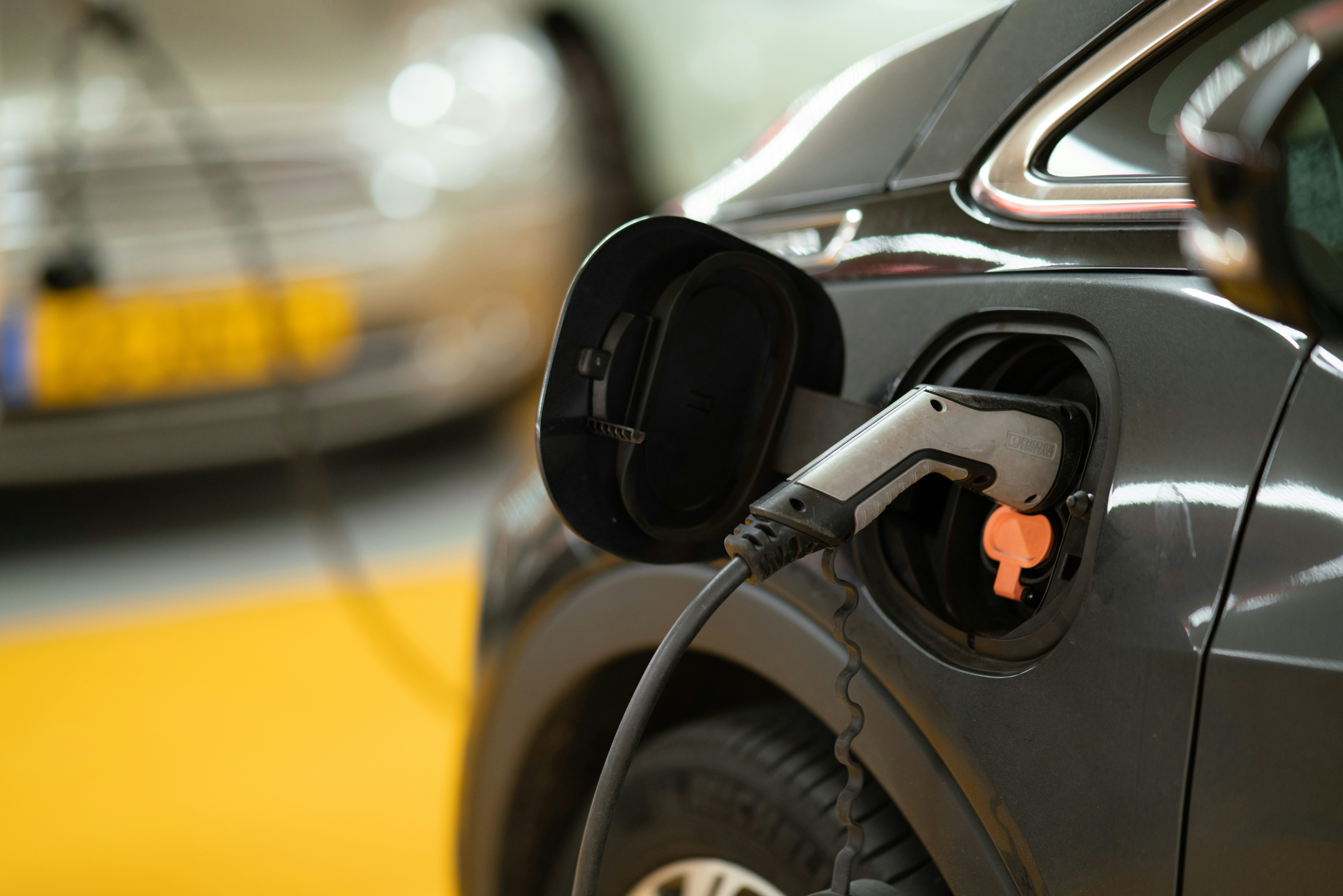
EV charging infrastructure is the whole installation that brings electricity from the grid to the car: grid connection, distribution board, protection devices, dedicated circuit, charge point and usually load management and metering. The charging station or wallbox is only the visible part.
If you have installed chargers elsewhere in Europe, most of this will look familiar, but Switzerland has its own sockets, its own grid-operator rules and its own standards. This guide maps each component, the four charging modes, the power limits set by network operators, who may install (NIV, NIN 2025, safety certificate), the SIA 2060 readiness levels and what a right-sized installation costs. Voltaback works with more than 200 companies on fleet charging. We do not install chargers, but we help choose the right setup for each employee and then reimburse home charging at real cost.
Updated 2 November 2026.
Charging infrastructure or charging station: what is the difference?
Charging infrastructure (Ladeinfrastruktur / infrastructure de recharge / infrastruttura di ricarica) is the complete system. The charging station or wallbox is the device on the wall or on a post. A station without a properly sized circuit, the right protection or notification to the network operator cannot be commissioned.
Why this matters for a fleet manager:
- Cost: in an existing underground garage, cabling and the distribution board often cost more than the wallbox.
- Procedures: it is the electrical installation that is notified to the network operator and inspected, not the device.
- Scalability: well-prepared infrastructure (SIA 2060 levels) lets you add chargers later without major works.
What are the components of EV charging infrastructure?
Grid connection
Everything starts at the building's connection to the distribution network operator (Verteilnetzbetreiber, VNB / gestionnaire de réseau, GRD): ewz or EKZ around Zurich, SIG in Geneva, WWZ in Zug, IWB in Basel, Romande Energie or municipal utilities in Vaud. The capacity of that connection caps what you can install without an upgrade.
Distribution board and dedicated circuit
The charger is fed by a dedicated circuit from the main board or a sub-board. Cable size depends on power and length. In shared garages a main feeder (often a flat cable) serves several spaces, and each charger is connected to it.
Protection devices
The Swiss low-voltage installation standard (NIN, SN 411000, the local equivalent of IEC 60364), in its 2025 edition in force since 1 January 2025, has a dedicated part on supplying electric vehicles (part 7.22). Each charge point needs its own overcurrent protection and a residual current device that also detects DC faults: either a Type B RCD, or 6 mA DC detection built into the charger combined with a suitable RCD. The installer makes the final choice.
Source: Electrosuisse e-mobility brochure.
Charge point
This is the station and its connector. The European standard for AC charging is the Type 2 connector. The cable is either tethered to the station or brought by the driver.
Load management
With several chargers, load management shares the available power so the building connection is never overloaded. It can be static (fixed limits) or dynamic (limits calculated from live measurements at the connection), and it also balances the phases.
The handbook of the Association of Swiss Electricity Companies (VSE / AES) gives orders of magnitude for residential buildings: about 9 kW in total for 1 to 5 charge points, 22 kW for 30 to 39, 55 kW for 50 to 99. Source: Stadtwerk Winterthur e-mobility sheet.
Backend
Networked chargers connect to a management platform, usually via the open OCPP protocol. The backend handles access badges, user rights, billing and fault alerts. It makes sense in a shared car park and is rarely essential at home.
Metering
To bill electricity to a third party or separate the car's consumption, you need a meter, ideally MID-certified, in the charger or the board. Some subsidy programmes require it: Basel-Stadt, for example, requires a utility meter for its grants.
The four charging modes and Swiss sockets
The international standard IEC 61851 defines four charging modes. Switzerland adds its own domestic sockets, which differ from those used in neighbouring countries.
Mode | Connection | Typical power | Use in Switzerland |
|---|---|---|---|
Mode 1 | Domestic socket, no safety device in the cable | Low | E-bikes and scooters, not cars |
Mode 2 | T13, T23 or CEE socket with an in-cable control box | About 2.3 kW on T13; 3.7 kW on T23 or single-phase CEE 16 A; up to 11 kW on red three-phase CEE | Emergency or slow home charging |
Mode 3 | Fixed charging station or wallbox, Type 2 connector, AC | 3.7 to 22 kW | Standard at home and in company car parks |
Mode 4 | DC rapid charger (CCS) | 50 to over 300 kW | Motorways, rapid charging hubs |
T13 and T23 domestic sockets are not designed for several hours of continuous load, and network operators advise against using them for regular charging. A CEE industrial socket fitted by an installer, or a wallbox, is the safer option. Our comparison of the best socket for charging an electric car covers the choices.
Which power: from 2.3 to 22 kW
Swiss network operators' technical connection rules (Werkvorschriften, WV-CH) contain a rule that often surprises newcomers: single-phase charging is capped at 3.7 kW (230 V, 16 A), two-phase at 7.4 kW. The single-phase 7.4 kW wallbox common in some other countries is therefore not a standard option here. Above 3.7 kW, you go three-phase.
Power | Supply | Energy in 8 hours | Range at 18 kWh/100 km |
|---|---|---|---|
2.3 kW | Single-phase, T13 (emergency) | About 18 kWh | About 100 km |
3.7 kW | Single-phase 16 A | About 30 kWh | About 160 km |
11 kW | Three-phase 16 A | About 88 kWh | Full battery for most models |
22 kW | Three-phase 32 A | Full battery | Only useful if the car accepts 22 kW AC |
Worked example: a 40 km daily commute in a car using 20 kWh/100 km needs about 8 kWh, a little over two hours at 3.7 kW. Most company cars therefore recharge comfortably overnight at low power.
Two further rules apply at most network operators:
- Above 3.7 kVA, the charger must be controllable by the network operator, often through a ripple control receiver.
- Above 11 kW, the operator usually has to approve the installation before commissioning; up to 11 kW, notification is enough.
Sources: Stadtwerk Winterthur, CKW, legal requirements for charging stations. Details vary between operators, and your installer will know the rules for your municipality.
Who may install EV charging infrastructure in Switzerland?
A fixed charger is a low-voltage electrical installation. The Low-Voltage Installation Ordinance (NIV / OIBT, SR 734.27) restricts this work to holders of an installation permit issued by the Federal Inspectorate for Heavy Current Installations (ESTI). In practice you hire a licensed electrician (konzessionierter Elektroinstallateur / installateur-électricien concessionnaire).
The typical process:
- Before work starts: the installer files a technical connection request (technisches Anschlussgesuch, TAG) and an installation notice (Installationsanzeige) with the network operator. All chargers must be notified, including portable units on an existing socket.
- During the work: the installation complies with NIN 2025, especially part 7.22.
- After the work: the installer issues a safety certificate (Sicherheitsnachweis, SiNa / rapport de sécurité) with measurements and test report, for the owner and the network operator.
An employee therefore cannot fit a wallbox themselves, even one bought online. To get and compare installer quotes, see our charging station installation page.
SIA 2060 readiness levels
The SIA 2060 technical bulletin "Infrastructure for electric vehicles in buildings" describes five readiness levels, from empty conduit to a working charger:
Level | What is built |
|---|---|
A (Pipe for power) | Empty conduits, cable trays, space in the board |
B (Power to building) | A supply line sized for the charging load |
C1 (Power to garage) | Main feeder in the garage within 3 m of each future charger |
C2 (Power to parking) | Supply brought to each future charger position |
D (Ready to charge) | Charger installed and ready to use |
The bulletin is not binding in itself. It becomes binding when a canton refers to it, as Bern and Neuchâtel do for new buildings. For the full cantonal picture, see our article on EV charging obligations in Switzerland.
Detached house, condominium or company site
Detached house | Apartment building (rented or condominium) | Company car park | |
|---|---|---|---|
Typical charge point | CEE socket or 11 kW wallbox | Wallbox on a shared feeder | Several 11 to 22 kW chargers, sometimes a rapid charger |
Consent needed | None, apart from notifying the network operator | Tenant: landlord's written consent (Art. 260a CO). Condominium (Stockwerkeigentum / PPE): owners' decision, usually a double majority (Art. 647d Civil Code) | Landlord, if the company rents |
Load management | Rarely | Almost always | Almost always |
Metering | Not needed to charge | Needed to split costs | Useful for sharing or re-billing |
Who pays for electricity | Employee, reimbursed by the employer | Employee via the service charge statement | The company directly |
Condominium source: SFOE and SwissEnergy condominium guide.
Step-by-step guidance for owners is in our article on charging stations in condominiums. A federal right to a basic installation for tenants and condominium owners is being prepared but has not been adopted.
What does right-sized charging infrastructure cost?
Not every employee needs a connected charger. Our installation recommendation simulator starts from the following Swiss assumptions, which you can change:
Home installation | Simulator assumption | Share of drivers |
|---|---|---|
Heavy-duty socket (CEE or T23) on a suitable circuit | CHF 600.– | 50 % |
Non-connected wallbox | CHF 1'800.– | 30 % |
Installation already in place | CHF 0.– | 20 % |
Right-sized average | About CHF 840.– per vehicle | |
Connected charger (for comparison) | About CHF 3'000.– per vehicle |
Calculation: 0.5 × 600 + 0.3 × 1'800 + 0.2 × 0 = CHF 840.–. For a fleet of 50 cars, the gap with fitting connected chargers everywhere exceeds CHF 100'000.–. Detailed price ranges are in our article on the cost of installing a home charger.
These figures are orders of magnitude. The real price depends on the distance to the board, the state of the existing installation and the network operator's requirements. Cantonal or municipal subsidies exist, mostly for apartment buildings.
Do you need a connected charger to reimburse home charging?
No. The tax authorities ask for reliable evidence of the kWh and their price, not for a specific device. A connected wallbox is just one way of measuring, and the most expensive.
Voltaback is 100 % software. Charging data are read directly from the vehicle (more than 48 car brands connected) and valued at the employee's real contract tariff: high or low tariff, solar power, self-consumption groups. Voltaback relies on the home's MID-certified meter, not on a standalone cable meter. The measurement was audited by an independent third party, with a 1.22 % relative error.
The company never receives drivers' location data, which simplifies compliance with the nFADP (nDSG), and Voltaback has been ISO 27001 certified since 2 December 2025. The full comparison of options is in our article on connected chargers for fleets.
Frequently asked questions on EV charging infrastructure in Switzerland
It is the complete installation that supplies the car: grid connection, distribution board, protection devices, dedicated circuit, charging station and, depending on the site, load management, backend and metering. The charging station is only one part.
Yes, as an emergency solution with a Mode 2 cable at about 2.3 kW. For regular charging, network operators recommend a CEE socket or a wallbox fitted by an installer, because domestic sockets are not designed for hours of continuous load.
Swiss network operators' rules cap single-phase charging at 3.7 kW to avoid unbalanced loads on the grid. If you need more power, you install a three-phase charger, for example 11 kW.
Only an installer holding an installation permit under the NIV, in practice a licensed electrician. They notify the network operator before work starts and issue a safety certificate at the end.
Yes, every charging station must be notified with a technical connection request and an installation notice. Above 11 kW, most operators require prior approval.
They are five readiness levels for a parking space: A (conduits), B (supply line), C1 (feeder in the garage), C2 (supply to the space) and D (charger ready to use). They are only mandatory where a canton or municipality refers to them.
Right-size the hardware, reimburse at real cost
Good charging infrastructure is sized to actual use: low power overnight at home, load management in shared car parks, and no connected wallbox where reliable kWh evidence is enough.
Managing a fleet in Switzerland? In 30 minutes we identify the right setup for each employee and the real cost of their home charging: talk to a Voltaback expert.
Recommended articles
Company
Fleet electrification in Switzerland: rules, roadmap and TCO levers
Fleet electrification in Switzerland: no company quota, but CO2 rules, the Climate Act and climate reporting. Roadmap, charging, TCO and CO2 avoided.

Company
Electric car taxes in Switzerland for company fleets: federal automobile tax and cantonal vehicle tax (2026)
4 % automobile tax since 2024 and 26 cantonal vehicle taxes: what an electric company fleet pays in ZH, GE, ZG, BS and VD in 2026, with a 20-car example.

Company
Total cost of ownership of an electric company car in Switzerland: EV vs combustion
EV vs petrol company car TCO over 4 years in Switzerland: automobile tax, cantonal tax, home charging at 28 Rp./kWh, 0.9 % private share. Worked in CHF.